The provincial election is coming up , called because weasel eby thought the asshole conservatives were in such disarray that he could skulk in and take advantage of that . Well, when you have no principles, it just isn't going to be that easy . At least he's got his ten dollar a day daycare spot for his child , the fucking snake . No doubt the asshole conservatives will take advantage of all the greasy shit eby's done , despite the fact that the racist shitmunching conservatives aren't any better . They just look like they are right now . I just can't stand any of it .
Watch as zelensky continues to beg the western vultures while putin makes deals with fuckface trump . This entire thing was a farce from the start , and as always the people are left to suffer from the decisions of the bourgeois leeches . The people need to liberate themselves from imperialist russia , despite zelensky and his bullshit .
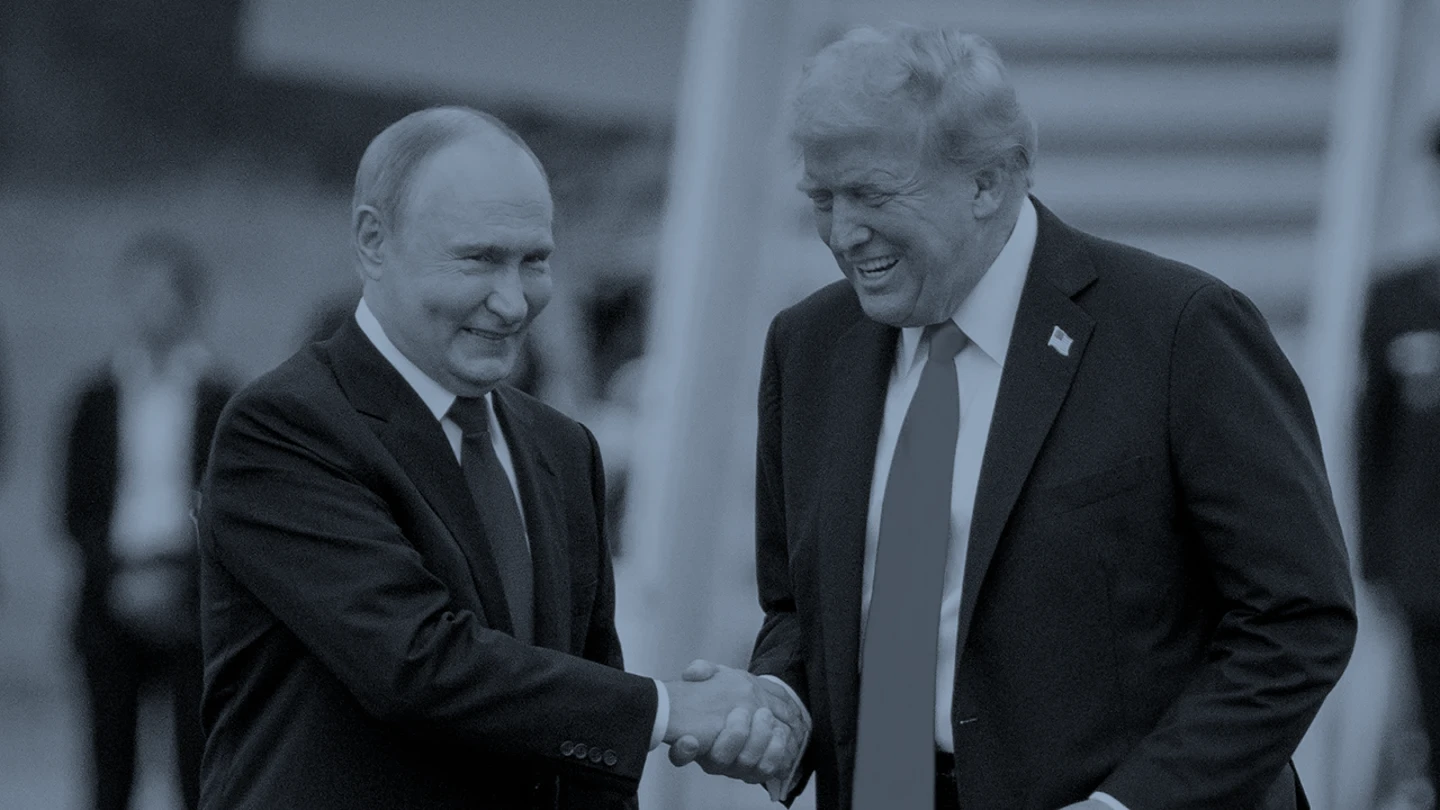
Featured image: Putin and Trump shaking hands at Joint Base Elmendorf-Richardson on Aug. 15, 2025 in Anchorage, Alaska. Source: Getty Images
On October 9, the US unilaterally lifted its sanctions on Russian oil in an aim to lower the ever increasing price of diesel. This comes amid the fuel crisis of Yankee imperialism, caused by the failed war of aggression on Iran and the subsequent blockade of the Hormuz strait and the vast energy infrastructure damage in the Gulf region – compounded by Russia’s decision to halt exports of diesel after Ukrainian strikes on vital energy infrastructure. Russian imperialism enters this deal seeking to expand its trade as an attempt to overcome some of the limitations that its relatively weak economic foundations impose on it, with the immediate purpose of filling its war coffers for its upcoming winter offensive in its war of aggression on Ukraine.
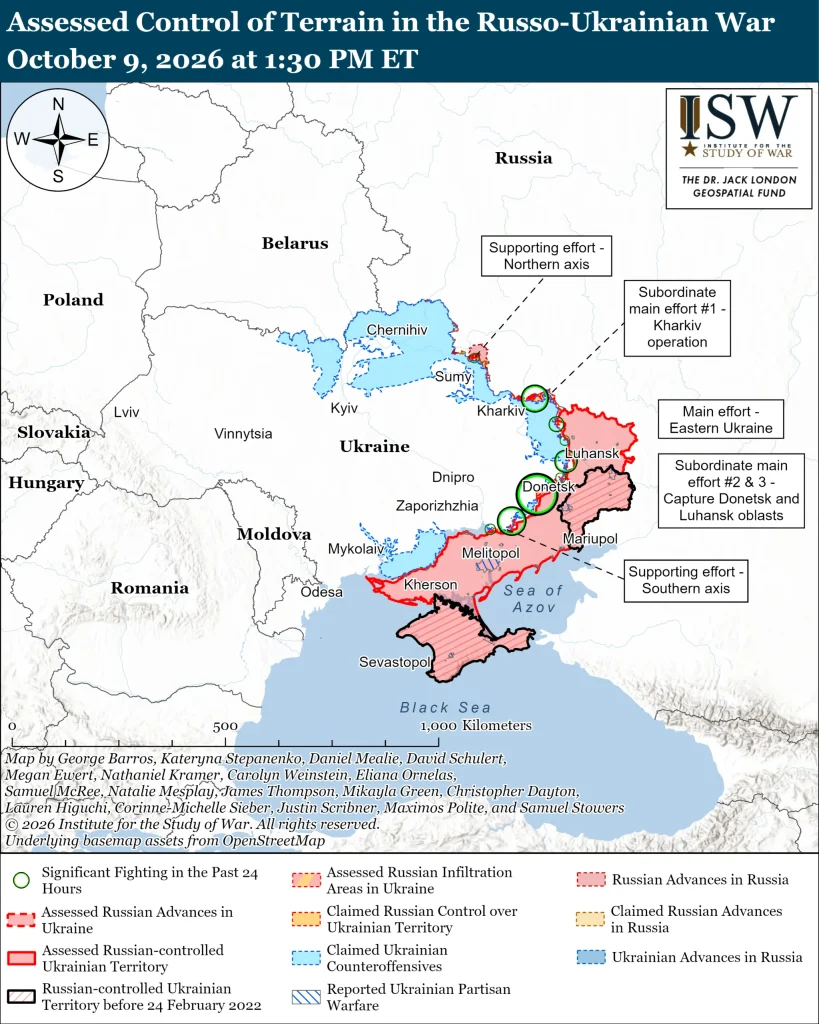
As the fourth year of the war of aggression on Ukraine by Russian imperialism nears its end, Russia is setting its aims on an intensive winter campaign, eager to convert their territorial gains on the now stagnant front lines into concrete concessions. Their aim is, as they have during every winter campaign in Ukraine, to make life during the cold winters of Ukraine unbearable for the Ukrainian people by targeting the main source of heating in the region, in an attempt at pressing their demands. Already in late September, Russia started heavily targeting energy infrastructure in Ukraine’s industrial east. In response, Ukraine has struck vital Russian oil refineries, prompting an export ban on diesel by Russia in order to maintain war preparedness and ensure energy supply in its offensive on the Ukrainian people.
Despite the concerns of Russian imperialism that attacks on its energy infrastructure might clog up its war efforts, throughout the Yankee imperialist war of aggression on Iran it stands ready to fulfill orders of shipments of oil and gas to the highest bidders when their imperialist competitors need to turn elsewhere for their energy needs.
Russia also seeks to take advantage of the firm ground that develops during the latter half of the winter season in Ukraine, putting an end to the so-called “rasputitsa” (mud-season), which makes traversal for armored vehicles much easier. This was also exploited during the winter campaign of Russian imperialism of 2025-2026 to intensify its armored assaults in Donetsk.
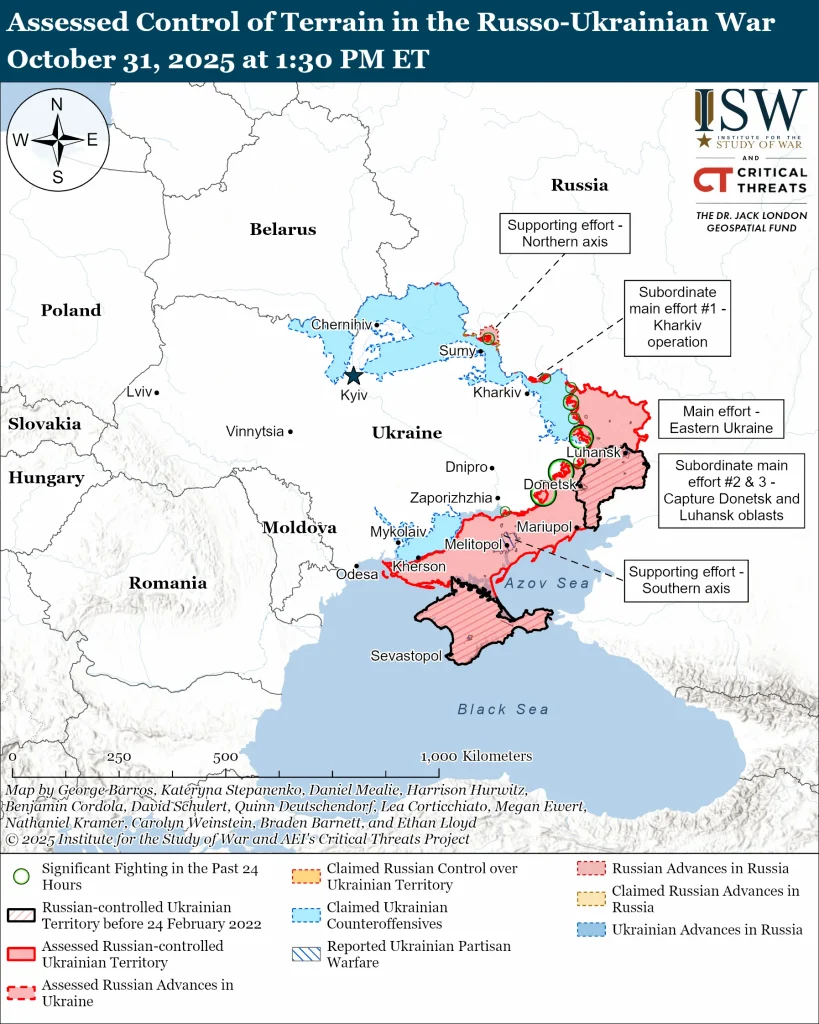
It is worth noting that despite fielding the fourth largest standing army in the world, Russian imperialism has after four years not been able to achieve its goals, and have found itself stuck in a quagmire on the Ukrainian front. As the front lines of the Russian offense have remained stagnant for the last year or so, Russian imperialism is slowly making the realization of other imperialist powers – that they cannot impose their will on the oppressed nations in the same way as before.
State of the front lines in the war of aggression in Ukraine as of October 9, 2026. Source: Institute for the Study of War
State of the front lines in the war of aggression as of October 31, 2025. Source: Institute for the Study of War
Here you can read our translation of a Punalippu article, detailing the recent attacks on Russian energy infrastucture:
Over the past week, the Trump regime has put pressure on Ukraine to stop targeting Russian oil refineries, citing concerns over the US diesel prices. In the same vein, on October 2, after an announcement by Emmanuel Macron, the imperialist powers of the G7 are now to release 100 million barrels of their emergency diesel and crude oil on the global market. The decision to release these 100 million barrels, was made directly after threats by Trump to halt the US export of diesel in an attempt to keep internal US prices low. In addition to the March decision by the International Energy Agency (IEA) to release 400 million out of their total 1,2 billion barrels of crude oil – the largest such release in history – this makes for a significant dent in the emergency reserves of the imperialist powers, forcing temporary trade agreements and alliances to shift in order to maneuver the ever decreasing supply of oil.
Zelensky Continues to Sell Out the Resisting People of Ukraine
It is not only the front lines of the war of aggression on Ukraine that remains unchanged, so does the country-selling character of the lackey Zelensky, who, as his people lay their lives on the line in defense of their land and freedom, continue to sell the resources of the Ukrainian people into the hands of imperialists.
On October 4, 15 arms deals were made with arms monopolies and contractors in Germany worth 8,5 billion EUR, including “counter‑drone capabilities – interceptors and small missiles, radars, UGVs, and artillery.” The funding for these deals is mainly the European Union (EU) loan of 90 billion EUR from April 23, 2026, as well as loans from the G7 Extraordinary Revenue Acceleration (ERA) of 33,8 billion EUR, the World Bank loan of around 20 billion EUR, and 12,9 billion EUR from the IMF – increasing the foreign debt of the Ukrainian government from around 86 billion EUR at the end of 2021, to 210 billion EUR as of May 2026.
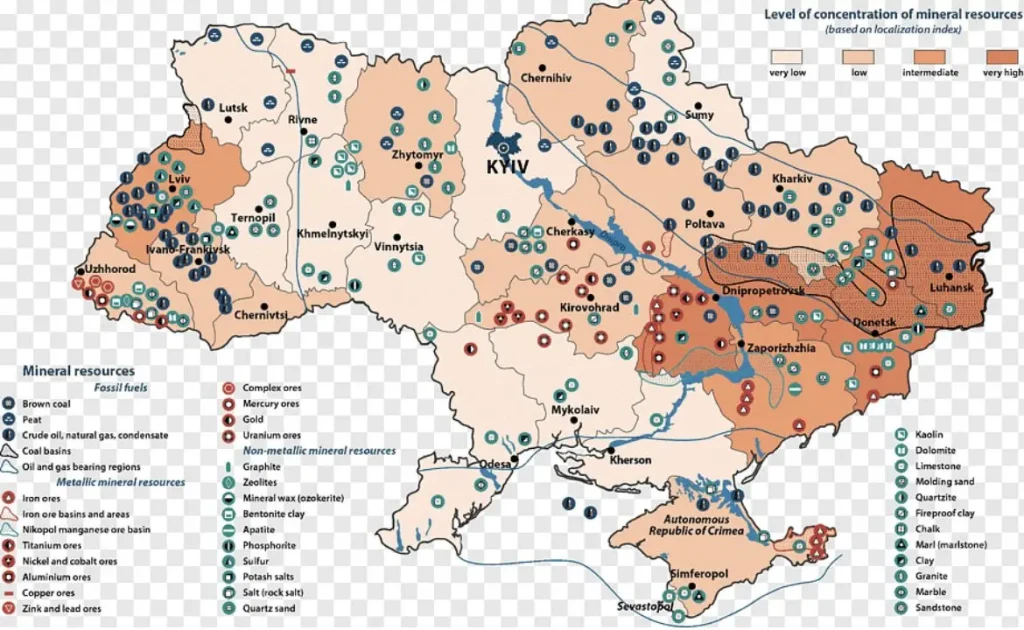
This debt comes in addition to the vast concessions made with Ukrainian resources and workforce, primarily to Yankee imperialism, but also to UK, French and German imperialism. In May 2025, a major extraction framework was laid between Zelensky and Yankee imperialism. Phrased as “reconstruction investment,” the deal lays the foundation for the extraction of vital minerals, oil and gas, and as Trump puts it himself, the “deal represents payback for the money the US has spent on the war so far.”
Source: Ithy
The so-called “100 Year Partnership” between the UK and Ukraine is another example. The “partnership,” following in the same imperialist extraction framework as with the US, ensures the advance of UK monopolies on Ukrainian land, especially in the extraction of hydrocarbons and critical minerals. In the same vein, Germany’s Rheinmetall, compounded by the recent “deals” made of mass-manufacturing drones in Ukraine, have entrenched themselves in the arms manufacture infrastructure in Ukraine through various deals. Similarly, France has severalagreements ensuring their hand in the arms production of Ukraine.
This comes on top of various corruption scandals where, among other incidents, Zelensky was implicated in the infamous Pandora Papers leak, revealing the transfer of large sums of money from companies affiliated with Zelensky, to offshore companies in British Virgin Islands (BVI), Belize, and Cyprus – which also implicated the then- associates of Zelensky, head of the Security Service of Ukraine, Ivan Bakanov, and First Assistant to the President Zelensky, Serhiy Shefir. Zelensky continues to fill his own pockets and those of the compradors and oligarchs in Ukraine, and sells out the Ukrainian people and its land, in favor of foreign imperialists and the Ukrainian bourgeoisie in the service of imperialists, instead of relying on the resistance of the people.
Conclusion
Despite the treason from the supposed “leadership” of the Ukrainian national resistance, represented by the comprador and lackey Zelensky, the Ukrainian people in resistance remain steadfast, holding the line against the onslaught of Russian imperialism. Despite the planned winter offensive of Russia – and the deals made with Yankee imperialism to increase its war coffers in an attempt at pressing its demands for territorial gain – the people of Ukraine will, and must, continue the defense of their land and freedom, and in laying its lives in service of this goal, the resistance of the Ukrainian people serve in a broadening front of wars of national liberation, and in deepening the crisis of the imperialist system. It is the task of the consequent anti-imperialist to increase the support of the Ukrainian People and do all we can to assist the comrades who struggle to give proletarian leadership to a National United Front in the midst of the War of Resistance.
Call it "the system" , call it politics , call it fucking democracy, but it's all shit and all corrupt no matter who or what you think you're voting for .
Remember this :
The bike lanes cost 65.5 million dollars .
The new Crystal Pool recreation centre will cost over 209 million dollars.
The city council wanted to spend over 12 million dollars on a Centennial Square renovation , but they stopped that for now .
In March of 2024 city councillors tried to give themselves a 25% pay raise in the face of rising property and other taxes, but they backed down due to public pressure .
And why not ? Everything is looking terrific !
The lost and sick have been let down by every level of government . This is inhuman . They pretend but they don't give a flying fuck .
Sometimes you might not like the source of an idea even if it is true. That doesn't mean the idea itself should be disregarded , especially if you've had your eyes covered by bougie propaganda your entire life and can't think on your own .
First of all, this is just my opinion , and I'm sure many people agree .
My opinion stems from his abandonment of the Declaration on the Rights of Indigenous People's Act . He helped write it , and the minute the courts upheld land rights of Indigenous people , he put it on hold , basically continuing the same racist colonial shit that every politician has .
The newest thing is the fact that his kid has a spot in the ten dollar a day childcare program . This asshole makes over 220,000 a year , his wife is a medical doctor , and he takes a spot from someone who actually needs it ! Watching him sputter and mumble his way through excuses was pathetic and disgusting . If you can justify voting for that , then that's on you .
And no , I'm not advocating for that pig doerkson , who promises tax cuts . Yes he'll deliver , but he'll also cut all of the programs those taxes were paying for .
Fuck all of these repugnant assholes .
This a portion of an article from The Tyee back in April :
In a short time, we have seen the premier abandon his party’s commitments to address the toxic drug crisis, climate action, affordable housing, access to justice — and now the human rights of the Indigenous Peoples of what is now known as British Columbia.
Premier Eby is selling British Columbians a tall tale about the Declaration on the Rights of Indigenous Peoples Act. He says that DRIPA poses “legal liabilities” for the B.C. government, but can’t say exactly how. He claims that the recent Gitxaala-Ehattesaht BC Court of Appeal decision has created an “existential threat” to the provincial government, forcing them to rewrite laws overnight, and plunging B.C. into chaos.
But when pressed for details, he can’t identify a single court case or petition that justifies the suspension or amendment of key sections of this first-of-its-kind Indigenous human rights legislation. The premier’s story neither reflects the reality of the court’s decision, what DRIPA actually does, nor the perspectives of First Nations who helped co-develop DRIPA.
The Gitxaala-Ehattesaht decision — like the many other similar court decisions involving Indigenous rights — requires the province to engage in good-faith discussions with Indigenous Peoples to effect change and resolve uncertainties. The court’s decision in Gitxaala-Ehattesaht did not order immediate sweeping legislative change, nor did it require all provincial laws to align with the UN Declaration overnight. Its findings focus on the current inconsistencies between B.C.’s mineral tenure regime and the human rights affirmed by the United Nations Declaration on the Rights of Indigenous Peoples. These inconsistencies have led to infringement of First Nations’ rights.
Can you trust the hypocrites who trumpet their democracy and whine about human rights when they don't give a fuck about any of that ? They care about their profits and that's all . When money rules everything you do, nothing else is important . The rest is just window dressing .
Would Stephen Harper attack Libya simply to justify spending tens of billions of dollars on F-35 fighter jets? Perhaps. But, add on doing it for major Canadian investors, reinforcing his “principled” foreign policy rhetoric and reasserting western control over a region in flux, and you pretty much have the range of reasons why a half dozen CF-18s four other military aircraft and naval frigate are currently engaged in combat 10,000 km away from Canadian soil.
Over the past few months the Conservative’s plan to buy 65 F-35 Joint Strike Fighter jets has become a serious political headache. A recent poll showed 68 per cent of Canadians — including a majority of Conservative supporters — agreed that “now is not a good time” to spend between $16 and $29 billion on these controversial single-engine jets. So, sending Canadian military aircraft to enforce a UN “no-fly zone” in Libya provides an opportunity to soften opposition to the F-35 purchase, an issue bound to be a hot topic in the election campaign that formally began Saturday. Most critics of the F-35 purchase — from the NDP’s Michael Byers to Project Ploughshares Ernie Regehr to Liberal foreign affairs critic Bob Rae — support the “humanitarian” mission in Libya. With these and other liberal interventionists supporting a bombing campaign in North Africa, Harper can more easily justify spending nearly $1,000 per Canadian on the best fighter jets money can buy. (Québec housing group, FRAPRU, claims the cost of a single F-35 equals 6,400 social housing units.)
Conveniently, the right-wing press has already begun to connect the dots in support of the Harper government. An Ottawa Citizen headline read, “Libya shows why Canada needs jets,” while a Sun Media chain commentary explained, “enforcing a ‘no-fly’ zone to shut down a dictator is an expeditionary air operation. Is that something Canadians want to be able to do in the future? If yes, you need an F-35, expensive or not.”
Over the past five years, the Conservatives have further militarized Canadian foreign policy. Military spending is at its highest level since World War II — the Harper government expanded Canada’s role in the occupation of Afghanistan, claimed that Russia is planning to attack and sent 2,000 troops to police Haitians after a devastating earthquake.
The Conservatives draw significant support from the military as well as its associated companies and culture. To get us in the fighting spirit, for instance, the Canadian Forces released onboard video footage of a CF-18 destroying a ground target in Libya.
But there is more to it than pleasing the Great White North’s version of the military-industrial complex. On March 21, The Financial Times reported that western oil companies were worried that if Gaddafi defeated the rebels in the east of Libya he would nationalize their operations out of anger at the west’s duplicity. Presumably, this includes Suncor, Canada’s second largest corporation, which signed a multi-billion dollar 30-year oil concession with Libya in 2008.
Home to the second largest amount of Canadian investment in Africa, instability in Libya has put a couple billion dollars worth of this country’s corporate investment in jeopardy. Dru Oja Jay, editor of the Dominion and a candidate for the Mountain Equipment Co-op Board of Directors, notes “Canadian investors are legitimately worried about what’s going to happen to the $1 billion signing bonus Suncor paid out to the Libyan government, or whether SNC-Lavalin is going to recoup its investments in the country, which is home to 10 per cent of its workforce.”And these are some of this country’s most powerful corporations. Embassymagazine includes both Suncor and SNC-Lavalin’s CEOs among the nine most influential business executives in determining Canadian foreign policy.
Would a victorious Gaddafi have moved against Canadian companies? Even if he didn’t, with all the bad press SNC and Suncor have received could they continue in Libya without regime change? Finally, will the rebels dependence on the west lead to better contract terms?
Unlike Egypt or Tunisia, the Conservatives denounced Gaddafi’s repression at the beginning of the Libyan uprising. This is partly because Gaddafi has never been on great terms with much of the West, even if there have been warmer relations in recent years. Also, the Conservatives were widely derided for supporting Egypt’s Hosni Mubarak and (to a lesser extent) Ben-Ali in Tunisia to the bitter end. So Libya gave Harper an opportunity to re-affirm his “principled” foreign policy rhetoric.
Beyond wanting to appear on the side of human rights and democracy, another element motivating the military intervention in Libya is the desire to influence the revolutions in bordering states Tunisia and Egypt, which are still in flux. Controlling Libya gives the West another point of leverage over developments in those countries. Bombing Libya tells democratic forces in the region that the west is prepared to use force to assert itself (as does tacit support for the Saudi military intervention in Bahrain).
Recent developments in Libya are a reminder that if you give the western decision-makers an interventionist inch they take an imperial mile. In principle trying to stop Gaddafi from massacring people in eastern Libya is a good thing. But, the “no-fly zone” immediately became a license to bomb Libyan tanks, Gaddafi’s compound and other targets in coordination with rebel attacks. On March 22, Foreign Affairs Minister Lawrence Cannon claimed the UN resolution allowed for “boots on the ground.”
Beyond the inevitable death and destruction in Libya, the security council resolution further undermines state sovereignty, which provides the weakest states with some protection from the most powerful. This is the main reason why many Latin American and African countries have opposed the intervention.
Finally, let’s put the current moral outrage in perspective. A little over two years ago Israel launched a 22-day onslaught against Gaza that left some 1,400 people, mostly civilians, dead. There, the power imbalance between the two sides was much greater and the aggrieved population had been under the boot of the attacking force for as long as Gaddafi has ruled. Yet there was no talk of imposing a no-fly zone over Gaza. In fact, the Harper government cheered Israel on.