
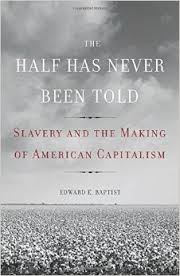
The fucking u.s.a. has been promoting itself as the world's greatest democracy since they were a slave-trading country. They try and maintain this myth even today, as they go aroung killing anyone in any country who disagrees with them. Read this interview with author Edward Baptist. I would love to read this book.
From The Michael Slate Show:
Vicious Slavery and the Development of U.S. Capitalism
February 2, 2015 | Revolution Newspaper | revcom.us
The following is a transcript of a January 30, 2015 interview with Edward Baptist on The Michael Slate Show, KPFK Pacifica radio.
Michael Slate: Every now and then you get the opportunity to read a book that really, really stuns you, that gives you a glimpse of the world as it is, and it's in a way that you never even imagined before, or that you didn't understand thoroughly enough before. That's how I felt when I read the book, The Half Has Never Been Told: Slavery and the Making of American Capitalism. It was a mind-blower. It's a book by Edward Baptist. He is a professor of history at Cornell University.
Michael Slate: What compelled you to write this book?
Edward Baptist: I was writing a dissertation, a kind of standard scholarly production, and I kept running across these accounts from formerly enslaved people, which of course had been written about by historians before, but I felt that there were layers to that story that hadn't been told, specifically the process of the expansion of the South and the way that linked into the development of American and in fact global capitalism. I think there's probably a bigger story which has to do with life experience and early education and what I saw as a child and a teenager in the 1970s and ‘80s. But the narrow version takes me right to that experience of reading those accounts that were left behind by formerly enslaved people, survivors of slavery.
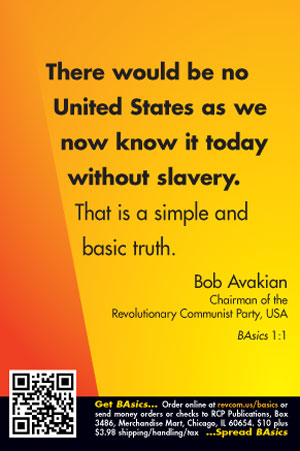
From BAsics, from the talks and writings of Bob Avakian. Order here.
Michael Slate: The way we're taught to look at it is that there was slavery and there was capitalism. There were the “good guys” and there were the “bad guys.” I remember going down to a beach in Maryland when I was a kid, and you'd see Confederate flags, and you had no idea what that was. But nobody ever told you this. Or we got my kid a “Dukes of Hazzard” pedal car when he was a kid, and he was incensed when we wouldn't let him put the Confederate flag stickers on it. I realized that at six years old, he was being given a different and untrue history of the relation between what they've often portrayed as two different, separate systems and not any kind of link together.
Edward Baptist: In a way, the fact that those Confederate flag decals are available when you’re buying a kid this car, I guess that was 1979 or 1980, something like that, the fact that that's available is a relic. It's a piece of evidence of the bargain I talk about, and lots of historians have talked about, that happens between 1875 and 1900, where northern whites and southern whites agree that they’re going to essentially forget that the war was over slavery. They're going to allow southern whites fully back into the leadership of the United States. And they're going to pretend like what happened didn't happen.
What happened, of course, was mass treason, a rebellion against the government for the purpose of insuring that slavery would be able to expand. And white people agreed not to remember it that way. On the other hand, African-Americans remembered it a different way. That's really obvious in the interviews with the formerly enslaved people. It's also obvious in the scholarship that African- Americans created over the 150 years since the Civil War. I've been rereading W.E.B. Du Bois recently, and I keep saying, “Wow! On some levels I'm not sure I've added anything new to what Du Bois said.” I mean, I've done my best, but this sort of analysis, that slavery and capitalism were linked, that slavery was the cause of the Civil War, this was deeply embedded in African-American history at every level, from the sort of told level that formerly enslaved people understood, to the academic level.
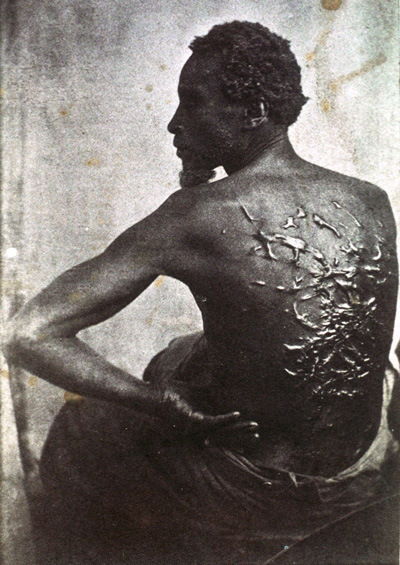
Gordon, who escaped from Louisiana slavery, 1863. Photo: AP
Michael Slate: The assumption that slavery was not part of the American legacy was something that was critically important for the way the U.S. portrayed itself both internally to its own people, but also throughout the world as sort of the bastion of freedom. These kinds of things wouldn't happen in a country like the U.S.
Edward Baptist: I think that's certainly true. We see sometimes in our history that the portrayal of the United States as a land of freedom is crucially important to what the United States is trying to do overseas, as well as to what the government is trying to do and what the economic leadership is trying to do in terms of building international coherence. We even see this in the 1950s and the 1960s with the Cold War. We see that there's a conscious effort to portray the United States as a land of interracial harmony, of African-American access and opportunity, whereas we know that that was not actually the truth.
Michael Slate: You said that the reality of all this is that the changes that shaped the entire world began on a slave auction block in the U.S. Let's talk about that.
Edward Baptist: This in some ways goes back to cotton, and here I've got to give a shout-out to Sven Beckert's new book about cotton which talks about cotton from a global perspective [Empire of Cotton: A Global History]. I'm much more interested in talking about it, or at least starting the story in the nitty gritty of people's everyday lives because I think that's where we see the transformations that reshape the world in the industrial revolution and the rise of capitalism. That's where they really begin. And in the United States, those transformations began with the production of cotton, the most important raw material of the 19th century, the petroleum, the oil, of the early industrialization of the West. They really start with the expansion of slavery into areas where cotton can be grown, and the purchase of individual enslaved people who could be driven at a faster and faster pace to produce that cotton more and more efficiently for that thirsty world market that's eager to consume more cotton.
Michael Slate: From the very beginning, U.S. slave labor was actually crucial to building the economy and the political strength of this country, right?
Edward Baptist: Not just the United States, but I think Western economies in general, but certainly most specifically, most obviously, the United States. If you look at that scene you just described which is repeated a million times or more in the history of the South leading up to the Civil War, the scene of an individual person being sold, whether in a showroom or on an auction block, you can see all the connections between that and American economic development. Specifically, there's a financial connection, because individual enslaved people were expensive. They were expensive to move, transport and resell. The price in today's equivalent could probably be about $200,000 to $250,000. so these purchases had to be financed. There were huge financial networks that helped to finance the movement of a million people from the older states of the South to the newer cotton states of the South.
Once they're there, once all those slices of profit have been taken in the process of financing the movement and the sale and the resale and so on – once they're there, they are forced to generate more profit. Tremendous profit, in fact, with an ever-increasing production of cotton. This cotton, as I said before, has a ready market. In fact, enslavers are incentivized to drive people to work faster and faster because they've got these big debts to pay back.
Michael Slate: As we opened up this interview, you said that some of the source material that you used were the stories that were recorded from ex-slaves. I was really surprised that you were able to include and actually frame your book in these stories, and reading about how the WPA [Work Progress Administration] sent people out to canvass the South and to find ex-slaves to tell their stories in the 1930s. Can we talk about what pushed you in that direction, because it was a very powerful way to begin, where these stories actually unfolded from voices that people don't generally conceive of even existing at a time when you could gather information from them.
Edward Baptist: It's a reminder that, first of all, slavery is a long time ago. It ended officially 150 years ago. But then on the other hand, in historical time, that's not that long. A lifetime ago, there were thousands, maybe tens of thousands of survivors of slavery still living. And they could be interviewed. They were in many cases happy to talk about what they'd experienced. Now in some situations they couldn't talk openly. They had to sort of disguise some of the things that they were saying, because some of the WPA interviewers were members of locally-powerful white families, and this was the Jim Crow South when it wasn't necessarily safe to say exactly what you thought about white people.
But other interviewers were African-American. I opened the book with the story of Lorenzo Ivy who's interviewed in Danville, Virginia. He's actually interviewed by an African-American master's student from Hampton University. His interview always struck me as incredibly powerful because he frames the story of slavery, and in some ways of American history, by talking about the coffles, the chained gangs of enslaved people being marched from Virginia on down to Alabama and New Orleans and so on for sale, as the key memory that he recalled from his own growing up.
He tells the story. He says, this is what I remember about slavery most clearly: separation of families by sale and forced migration, the movement of people in chains, how all of that fed into the cotton economy. And then he says to his interviewer, “Truly, son, the half has never been told.” And I read that, and I said, I have to frame the book around this interview. It absolutely has to happen this way, because we owe so much to those voices. We have to open with those voices and go backwards in time from there.
Michael Slate: There's a method that runs through your entire book. In telling the story of one of the most grotesque, dehumanizing events in the history of humanity, you frame everything with a very deep concept of humanity, of really needing to portray the humanity of the enslaved people.
Edward Baptist: Yeah. I try to do that. And again, I think lots of other historians try to do it that way as well. But specifically in my book, I lay it out in a series of chapters named after body parts. And there are two reasons why I do this. One is that I was reading an essay written by Ralph Ellison and thinking about that essay. In that essay, he says, we should really think of the history of America as a drama enacted on the supine body of a “Negro giant.” He's writing in the 1950s. And this person, who's tied down like Gulliver, as he puts it, is central to all the action, the frame of all the action, part of all the action, but not able to fully act as he or she would want to act. That's the metaphor that really struck me and I started thinking about it. Then I started thinking about the ways in which enslavement as it was practiced and brought in some ways to its highest level in the American South in the early 19th century, literally tried to turn African-Americans bodies against African-Americans as persons, as people.
So when people were chained and forced to walk south, their feet were not chained, but their arms were chained. They could not resist. They couldn't fight back. In fact, they were all chained together to make it harder for them to run away. And we could continue with the ways in which bodies are turned in certain ways against personhood.
And yet, African-Americans also, as enslaved people, found ways to re-appropriate, to take back their bodies, even if only for moments, as ways to struggle against slavery. So that the simple act of survival and helping one's family members to survive was a kind of resistance to the deepest, cruelest things that slavery was trying to do. I tried to enact that in the structure and in the writing of my book.
Michael Slate: You open the book up with a section on the rapid expansion of slavery in the Deep South in the 1790s. When you're talking about the coffle, one of the things that struck me about the book is that you portray, in the grotesque dehumanization and torture of the people who were actually locked up, chained together and forced to walk, this massive migration to the Deep South, this enforced migration. But you also talk about how this coffle was about more than just chaining the slaves together, that it was actually chaining the early republic together. Let's talk about that.
Edward Baptist: One of the questions that the framers of the country and of the Constitution had to face in the 1780s, is how they can get local elites and migrants, settlers who are going to be expanding westward, how they can get them to actually participate in this new republic, how they can link them together as the size of the country expands. This expansion was seen as a big problem, because most countries were not as big as the United States was even in 1783, and if you're talking about moving to the Mississippi and beyond, you're looking at a continental scale of a country.
So one way to do it would be to create relationships of credit and debt, financial networks that would link people in disparate places together, and give them a reason to support each other's interests, a reason to work together to help the country to prosper economically. So the fact that enslaved people can be moved, can be moved by force and can be forced to labor at the production of valuable commodities by force, actually ends up linking New England and the Deep South together very effectively by 1800. Because these credit networks are set up in which New Englanders invest in the purchase of land and slaves by entrepreneurs who were moving from South Carolina or Georgia, western Alabama or Mississippi, or even in some cases from places like Pennsylvania or New England itself, into those new cotton areas.
So both of these regions of the country have a tremendous interest in seeing the other region succeed. The entrepreneurs in Mississippi and Alabama want New Englanders to be able to lend money to them. And the New Englanders, on the other hand, and there are also people in New York and Philadelphia in the same boat – they want to see these individuals, these entrepreneurs down in Alabama and Georgia and Mississippi selling commodities to the world market so they can pay back the debts. So this massive investment in the expansion of slavery actually ends up linking the United States together pretty effectively by the early 1800s.
Michael Slate: You talk about how the economic and industrial expansion in the world also depended on slavery in the U.S.
Edward Baptist: In terms of the expansion of the world economy, probably the single biggest factor is the way that the expansion of slavery in the United States, and the intensification and the innovation within slave labor in cotton, actually brings down the price of this crucial commodity, cotton, even as world demand for it is increasing.
So in the 1780s, raw cotton is pretty expensive. It's expensive for two reasons. It's hard to pick, and it's also hard to process. It's hard to get the seeds out of the cotton. Most of what is coming to Britain from the world market and is being used in its early factory system is coming from India and from the Middle East. Some is coming from the West Indies. Some is coming from China. Very little is coming from the American South, and it's pretty expensive.
The cotton gin helps to solve one of those problems. It makes the processing part of cotton production much easier. But cotton still has to be picked. The speed of picking cotton becomes a limiting factor in all production of cotton. It's the bottleneck in the production process. What enslavers are able to do as they take individuals and groups of enslaved people, they move them to new places, they break up their families, they dissolve their networks of resistance that enabled some 18th century slaves to slow the pace of labor. As they move them, they also discover a new system of measuring enslaved people's labor every day, assigning them quotas based on what they've been able to pick in the past, and then slowly raising those quotas over time.
So over the period from 1800 to 1860, the amount of cotton the average enslaved person picks per day rises 400%. So the price of raw cotton on the world market declines, even as the demand for it is increasing. It's as if, as we use more oil, the price was getting rapidly cheaper and lower all the time. That wouldn't necessarily be good for the planet, but it would produce a higher raw economic growth rate. So the increase in the speed of production of slave cotton enables the world market and the early capitalist economy to expand much, much more quickly.
Michael Slate: Let me ask you about Thomas Jefferson and his role in this, because here he is, the guy who is universally promoted as the father of democracy, true democracy, Jeffersonian democracy. Yet he played a very important role in this whole development of capitalism and slavery together.
Edward Baptist: Yeah, in some ways Thomas Jefferson is a tragic story, although the tragedy you see with his compromise of his own principles is minuscule compared to the tragedies that he personally inflicts on families that he breaks up as a slave owner. He sells people off repeatedly to pay his own debts. He doesn't free the mother of his own children, etc. But more broadly, some of his other choices end up having tragic consequences.
Specifically, as he shifts into recognizing, certainly implicitly, that the expansion of slavery is good for the expansion of the American economy and the unity of this expanding country as a whole – as he makes that shift over time, and as he moves into higher and higher positions of political power in the new republic, eventually becoming president, he becomes a more and more active agent for the expansion of slavery. Nowhere do you see this more clearly than in 1803 with the Louisiana Purchase, in which he acquires nearly a million square miles of land, if I've got my figures correct, from France. And he does it knowing full well that slavery is going to expand into this new territory, and it's going to link together a new slave empire.
Michael Slate: I'm thinking of people like Andrew Jackson as well, if we go down the line, all these people who were presidents and actually were advocates of slavery. It's not one of those things that's hurled into grade school history books: Presidents: slavery lovers! But each one of them, in the interest of developing the country and its place in the world, and the entire economy and the relationship between capitalism and farming and slavery, they weren't saying, “I've really got to go up against this. This is really immoral. It's inhuman.” They were actually facilitators of this.
Edward Baptist: Absolutely. Up until Abraham Lincoln, you do not have a single president who comes out and says, “We should stop the expansion of slavery,. That should be our policy, to block the expansion of slavery.” The one asterisk you can put in there is there's some suggestion that Zachary Taylor didn't want to see slavery expand, certainly he tries to ensure that California does not enter the Union as a slave state. But every other president presides over the expansion of slavery in some way, shape, or form, and some are particularly active agents of it, Jefferson and Andrew Jackson most obviously. But even people like James Buchanan are presiding over the expansion of slavery, into new territories, and in some cases into territories that had been more or less or sometimes explicitly declared free. Up until Abraham Lincoln, that is the unending story of American presidential politics.
Michael Slate: This is about the Louisiana Purchase. One of the things that you brought out, and I hadn't seen it brought out before, is the revolution in Haiti and what happened there, the most radical revolution in the world at the time, and the most radical definition of citizenry, and yet it also opened the door for the most massive expansion of the inhuman slavery in the U.S. with the Louisiana Purchase and all this. Can we talk about that?
Edward Baptist: It's one of the powerful ironies of history. As you say, the Haitian revolution is in some ways the most radical revolution in human history by some measures. Up until the late 1790s, the expansion of a certain kind of sugar slavery was one of the big engines of the Atlantic economy. Typically this depended on the importation of enslaved Africans, most of whom did not have children, so you have a continual die-off and turnover of enslaved populations, particularly in the Caribbean islands and northeastern Brazil. This is very profitable for the world economy, and nowhere is it more profitable than in the western part of the island of Hispaniola, the French colony of Saint-Domingue, which becomes Haiti ultimately. It's a tremendous reversal in human history, where this very powerful, very valuable in its most prosperous incarnation, this one colony which is the leading sugar colony in the world, probably the most valuable real estate in the world, in August of 1791, 100,000 enslaved people rise up and start to burn sugar plantations. They almost capture the capital. And that launches a 13-year process which ultimately ends in the defeat of Napoleon's armies as he tries to recapture Saint-Domingue and turn it back into a slave colony, and the declaration of an independent country.
Haiti's had a tragic history before, during and since the Haitian revolution for all kinds of reasons, but I think we can certainly celebrate the revolution as a moment in human freedom. And yet that revolution also convinces Napoleon to sell Louisiana to the United States, which he was not planning to do. And that sale opens up the entire Mississippi Valley to the expansion of a brand-new kind of slavery, a second slavery, some historians have called it, I think in a really evocative phrase. We have the first slavery which is that on the islands primarily, and it's driven first and foremost by the importing of slaves from Africa. And then you have a second slavery which is tied indirectly to the industrial expansion of the capitalist economy in a brand-new way.
Michael Slate: You have around the same time the 1811 Rebellion in New Orleans. I'd like you to tell people a little about what that was and what its significance was.
Edward Baptist: The 1811 Rebellion was one of these events in U.S. history which at least until very recently, definitely has not made its way into the textbooks. But it's probably the largest slave revolt up until the Civil War in U.S. history. Ultimately, as many as 500 enslaved people were gathered together in a sort of impromptu army. But clearly the revolt was also planned as well by a group of insiders who start about 50 or 60 miles from New Orleans on sugar plantations there and attempt to kill enslavers and gather more forces as they march towards New Orleans, which is the capital of the New Orleans territory as it's called at that time, and really is the most important city in the American West.
Had they captured that city, and had they been able to hold it, which are of course big “ifs,” you don't know what would have come about as a result of that and as a result of the spreading use of the success of that revolt throughout the South. The fact is that enslavers in the United States had learned lessons from the Haitian Revolution, and they perhaps had skill sets that the whites in Saint-Domingue had not mastered. They were better armed; they were better organized. They had the federal government behind them. Federal troops helped to participate in putting down this rebellion. And they ultimately do put down this rebellion.
The fact of the failure of the rebellion, and the success of those who put it down, points to something very important that we need to understand about slavery in the U.S. South, which is that it's fine to ask the question, why wasn't there a rebellion? Why didn't enslaved people overthrow slavery if it was so bad? The reality is it was impossible in the U.S. South to do this because it was so bad. Whites were a majority in virtually every southern state. They figured out the problem of how to maintain white unity. They were very well-armed. They were on the alert most of the time. And above all they had the cooperation of the federal government in maintaining slavery. What was increasingly one of the most powerful governments in the world was fully committed to putting down slave revolts. It's only in the Civil War, when the power of enslavers is really severely threatened by their own rebellion against the government, that enslaved people are actually able to find situations in which revolt is not suicide.
Michael Slate: Let's go back to the idea of naming the chapters after body parts. I was struck with, in reading about the 1811 revolt, the ferocious, barbaric response that the system made to the rebellion: the beheading of people, the posting of people's heads on poles all up and down the levees. After you talk about this, you get into chapters that you call “the right hand” and “the left hand.” What's the significance of that? Why the right hand and then the left hand? Because I think they do go together in a way.
Edward Baptist: The religious reformer, theologian, whatever you want to call him, Martin Luther, really fruitfully lays out, when he's talking about what his idea of god is, a definition of different kinds of power. He talks about right-handed power and left-handed power. Right-handed power is the god who comes in and smashes bad people and stomps all over Israel when Israel is doing bad things or stomps all over Assyria when Assyria is trying to conquer Israel. But left-handed power for Luther, and I think for a lot of people, is more interesting, because in his theological conception, left-handed power is the quiet god, the god who works in the dark, the god who works through people who society sees as weak, and through sort of secret pathways, and things we don't see, the power that is the seed lying in the cold ground that's going to sprout unexpectedly just when it seems like winter is going to last forever.
What human societies had been composed of for a very long time by 1800, I would argue, is a balance between right-handed power of the state and organized religion that told people they had to act like they believed X, Y and Z – and then left-handed power on the other hand, which would be peasant traditions, secret beliefs, secret peasant societies in some cases that resisted organized power. And in the workplace, the solidarities that people had, the ways of slowing down together so that nobody got in trouble but also nobody got super-exploited, the ways of passing down secret crafts from father to son or mother to daughter, so that oppressors always had to negotiate with the oppressed in order to get what they wanted out of the skills that craftsmen and peasants possessed.
This was the balance in human society. It's even the balance in some forms of slavery that you see, even in the 18th century South. And that balance is broken in the 1800s. You can see this most clearly in the expansion of cotton slavery. On the one hand, enslavers’ right-handed power is clearly expanding as the American state comes to conquer more and more territory, as they're able to muster the military power to intimidate enslaved people so they don't revolt, as they're able to forcibly move people from place to place.
But the enslavers are also conquering the terrain of left-handed power. In the American rice swamps, the rice plantations of the 18th century, enslaved people were able to establish limits. They were able to negotiate limits to the amount of work that they did in the course of a day. And part of that was because enslavers didn't always know how to do all the work that was done on the rice plantation. Part of that was also because over time enslaved people were able to establish customs, were able to convince enslavers to follow those customs, and were able to, together, effect a slowdown in work, if enslavers pushed back against those customs and tried to speed up work.
When enslaved people are moved, separated from their families, often as young teenagers – most of the people who were moved by the domestic slave trade are under 20. They're between 12 and 20. And as they're moved and they're brought into new places, and they're confronted with terrifying power, they're also confronted with technology, the technology of measuring their work, inflicting daily punishment if they don't meet a daily quota, and then forcing them to speed up that work over time. What is happening in effect is also that their left-handed power is being taken away from them. It's much harder to figure out a way to slow down work together in those kinds of conditions. It's much harder to hold secret the knowledge that you could pick a little faster if you had to, if you're being forced every day to pick faster, and then to learn a new way to pick even faster than that.
That's why I lay out those two chapters, right hand and left hand. I'm showing the expansion of both right-handed power on the part of enslavers, and the way that they conquer this terrain of left-handed power.
Michael Slate: You already started talking about the invention of the cotton gin, and how that was going to be a big advance and make things go much faster. But you point out that the key element is the enslaved people who are working it. You talk about the pushing system, the use of torture, the whipping machine, all that as ways that the enslavers found to force the people to actually step up their output in murdering ways. Just the immense torture it must have been on the body, both figuratively and literally. And people should understand: this was all crucial to the industrial revolution as a whole and the birth of the new world as a whole.
Edward Baptist: Remember the figures that we now have which show that there's a four-fold increase in the amount of cotton enslaved people are picking per day from 1800 to 1860. And a little bit of that might come from improved seeds or other sorts of changes in the biology of the cotton plant. But the cotton still has to get picked. It has to get grown, and it has to get picked. So enslavers have two separate innovations. The first is called by survivors of the system, it's called in some places the pushing system. This happens in the part of the production process running up to the harvest. Actually plowing, planting, cultivating the soil, using a hoe, in other words, to chop out all the weeds. What enslavers start to do, and this is not the system in rice and it's not the system in tobacco, is line up everybody, or sometimes they break them up into groups of 10, take the fastest person in each group, and tell that person, “If I see you slow down, you're going to be in for a whipping at the end of the day,” or sometimes directly in the field. And then they just have to tell everybody else, you've got to keep up with the fastest guy, or else you're going to get whipped on the spot. They concentrate on driving the faster people, the captains, and they force everybody else to keep up with them. This is what's called the pushing system. It allows the amount of land cultivated by each “hand,” as enslavers start to call enslaved people, to increase dramatically. And this puts more cotton in the fields.
Cotton, on the other hand, still has to get picked at the end of the year. And this is, as I said before, the bottleneck to the system. It's the slowest part of the production process. I read a WPA interview with a guy named Henry Clay. He was named after the perennial presidential candidate from Kentucky, this famous American politician. And he was born in North Carolina and moved to Louisiana in his teens. He was asked by his interviewer, and remember, Henry Clay is in his 80s or maybe early 90s by now – he's asked what that was like, and he said, well, my enslaver was a very clever man. He had something he called the “whipping machine.” The interviewer asked, what was the whipping machine? And Henry Clay said, well, it was a whole contraption. It included a board where somebody who didn't work fast enough was tied face down on this board, and above the board was suspended a wheel that had a lot of long leather straps attached to it. And that wheel in turn was pumped by a sort of pulley and treadle system. So if somebody pumped a treadle with their foot, just like an old-fashioned sewing machine, this would turn the wheel, and it would beat the enslaved person faster than any one human being could do.
It's possible that this machine – this instrument of torture – actually existed. Enslavers were very creative. In my research I ran across dozens if not hundreds of different kinds of tortures: everything that you read about from Guantanamo or Abu Ghraib, it already happened at some point or another in the American South. But it's also possible that this was a metaphor. It was a metaphor for another system that I discovered. This system I sometimes refer to in the book as the whipping machine using Henry Clay's technology. And this was the system of measuring people, measuring their output each day, and then whipping them if they don't meet their quota – and then raising the quota.
One person, Israel Campbell, who was moved from Kentucky to Mississippi, reported that, when he got to Mississippi and he was put into the cotton fields, he was told he had to pick 100 pounds a day. And he could never pick more than 90. So the enslaver started saying, well, you owe me a debt of 10 pounds. I'm going to account it in this way: one lash for each pound short. So I'm going to give you 10 lashes at the end of the day.
The systematicity of this, the way in which everything was linked: measurement, the recording of output, the accounting system which underlies all of this, and then of course the torture which drove the system, pushed people to continually find ways to pick faster and faster, but sometimes in extremely difficult, personally painful ways, whether physically or psychologically painful. The idea of having to pick as fast as you can all day, knowing that you may face something really horrible at the end of the day if you cannot do it, obviously spurs innovation, but is in itself a form of constant psychological trauma.
Michael Slate: All of this leads to something really important in your book: the slave response to all this, the enslaved people building community. How can you out of millions of people thrown together with completely different experiences, oftentimes different languages, traditions, all that? You talk about two things. The role of music is first, and then the idea of storytelling, and even the creation of an oral history that incorporated the word “stole,” which hadn't been used in relation to this. It really set a whole new spin on the character, the essence, of what was going on. Can we talk about that response?
Edward Baptist: In a situation like the situation that enslaved people found themselves in, particularly when they’re ripped out of their communities of origin, still communities that are enslaved, but communities that are quite different, and in certain ways much richer, with much more heritage and so on, and put into these individualistic situations, potentially individualistic situations, where they don't know the people who are around them. They don't necessarily trust the people who are around them, where every day brings a new kind of threat, and potentially a new kind of betrayal or danger. When you're put in that situation, it seems to me you have two choices. One is that you can go into yourself, try to protect yourself, and another is that you can reach out to other people. And obviously, there's a whole array of individual responses for the enslaved people who go through this process. We can find lots of people who behave individualistically, self-destructively, others destructively. You can certainly find that. But you also find this astonishing response that I think was probably the majority response, and that's the response of actually building community.
We see this in a lot of different ways. We see this in the development of literally a new dialect, a new accent. What we understand today as sort of the main, central stream of African-American dialect, in certain ways, scholars of linguistics tell us, is found in the mid-South region, stretching from Kentucky and Tennessee, down into Alabama, west Georgia, Louisiana, Mississippi – exactly the area to which enslaved African-Americans from all over the United States had been brought and put together in the early 19th century. It's pretty obvious to me that what they do is they figure out a way to talk to each other. And over time that is enriched and reproduced. And of course, African-American language continues to change rapidly in this country. But that's a key origin point, and it lies in the decision of people to literally talk to each other, form a common dialect, form a common new vocabulary and so on.
Music, as you said, is also crucial to that. Music is something in particular that always resists our attempts to intellectualize it, and it's constantly changing, and we cannot really put on paper the ways in which it animates life and brings people together or pulls them apart. But it's pretty obvious from the history of world popular music that African-American popular music, and maybe especially the genres which either originate or have significant contributions from that Mississippi Valley area, that these are tremendously successful and influential musical genres in the history of the world. From blues and country, which of course has African-American origins, jazz, rock 'n' roll, R&B, and even hip-hop, which to a large extent is founded by migrants or the children of migrants from that region.
These have tremendous influence. And there are a lot of reasons for this, and not all of them have to do with the fact that a million people were brought there, and they were told to figure out a way to survive or else die. But it seems clear to me, and there are a lot of sources that I think confirm this, that the process of survival required, as a lot of African-American authors and scholars have pointed out, continual innovation, even in music. So that's another thing that brings people together and helps them to survive.
But you talked about this use of language and the interpretation of history that develops in the slave labor camps of the cotton South, and this I think is in certain ways the most historically significant of all of these processes of survival. Enslaved people get together. They talk about, at the end of the workday – we've got a lot of sources that confirm this – they talk about how they got to where they are. In some point in that process, in community after community, they start to understand that what's happening to them is something that's very big, that it's transforming not just their own lives, but it's transforming the world. And even though it's being justified by whites, it is powerfully unethical. It's criminal. They come up with a vocabulary drawing on African roots, on African-American roots, on religious roots, on political roots, and on their innovation. They come up with a vocabulary for describing the process as one of theft. They identify some of the key points of it, some of the key crimes that are involved in this larger crime of theft, and they come up with a sort of canonical way to describe it. This is very crucial. It's very crucial to say, we're all going through the same thing. There's no individual escape from this. This is a collective process. This is something which forces us all to think about it in more or less the same way, if we're really going to identify what's going on and figure out how to survive and push back against it.
It's important for two reasons that enslaved people do this. And again, I'm not saying that everybody thought the same thing. But there are an awful lot of people that contribute to the process of coming up with this critique of slavery. It's important for two reasons, as I said. First of all, for African-American unity. If you compare African-American political unity to the political behavior of the descendants of enslaved Africans in other countries in the western hemisphere, what you see is that there's a difference between those countries like the U.S., where the descendants of formerly enslaved people tend to identify with each other, and those countries where there's identification with other aspects of identity. If you look at Brazilian identity, for instance, there's not a coherent Afro-Brazilian identity in the same way that you have a coherent African-American identity. This produces different political behavior. Afro-Brazilians do not all vote for the same presidential candidate. Of course, not all African- Americans vote for the same presidential candidate, but they do so to a much greater extent than other ethnic groups in the United States. That is a product, I would argue, of this process of producing a unity through understanding one's history, and understanding one's history as a collective process which is inescapable. There's no way out of this common identity, so we have to find a way to work together to make the outcome better.
The outcome is better because when people do escape from the Deep South, and there's only a few of them every year, but they bring this very powerful story, this story which is almost unanimous in its shape and its form and its key points. That radically shapes, it transforms the abolitionist movement in the United States. Formerly enslaved people repeatedly push white abolitionists to abandon the idea of “colonizing,” that is, sending all African-Americans out of the United States, to abandon the idea of gradual emancipation, and convince them that what is going on in the Deep South is so horrific that it has to be opposed whole cloth. It has to be taken down and destroyed. The radicalism of the abolitionist movement eventually splits the American political system open and leads to Lincoln's election, and to the southerners' reaction to Lincoln's election, which in turn brings about the Civil War and emancipation. So there’s that process of developing a political unity and a powerful, relentless, uncompromising critique of slavery as a crime, as a theft. That is absolutely essential to ultimately the end of slavery, bringing about emancipation itself.
Michael Slate: You've described the 1830s as a hinge of U.S. history, that by the mid-1800s, slavery is driving the expansion of U.S. industry, you have the role of the banks in that, you have all this stuff that's going on, the impact of 1837 and 1839, the economic crises that developed there. You had this really close relationship between slavery and industry, capitalism. But something happens in that period from the 1830s on that actually pushes things to the extreme where a Civil War does have to break out.
Edward Baptist: The 1830s are crucial both to the expansion of slavery in the U.S. and to the development of capitalism more broadly, because on the one hand, it's a decade where you see this furious, absolutely rapid expansion of cotton production in the United States and forced migration. Probably a quarter of a million people are moved in this one decade into the new states. You see the enslaved population of Mississippi multiply two or three times over. The production of cotton also doubles.
All these things happen in part because the United States and more broadly western capitalism make a massive investment, a massive bet on the expansion of cotton. In some ways it pays off. You have this flood of investment flowing in. It's attracted in part by the chartering of all these new banks, the deregulation of the American financial economy by the cotton planter Andrew Jackson which then allows all these banks to expand their lending massively. British lenders, western European lenders, northern lenders, these are all crucial to the expansion of the domestic slave trade in particular.
But the only catch to all that is, as enslavers are able to borrow all this money, buy all these individuals, move all of these 15-, 16-, 18-year-olds into Mississippi and Louisiana, put them in the cotton fields, force them to pick faster and faster – the only catch to all of that is that the production of cotton doubles. And this slowly brings down the price of cotton over the course of the 1830s. And of course, all of these enslavers are relying on revenue from cotton to pay back the mortgages that they owe. It's sort of like in 2008 when everybody was depending on that house that they planned to flip and resell for a quarter of a million dollars when they paid $125,000 or whatever – they were relying on that to pay back the mortgages that they had taken out in 2004. The consequence in some ways is very similar. You see a financial-market collapse in 1837, which is driven by the collapse in the price of cotton. Then there are all sorts of efforts made to re-inflate the market. And these bring about another crash in 1839.
Two things come out of that process. The first is that for about five or six years after 1839, the southern economy is in the doldrums. It's really suffering. There's a lot of what people today would call debt overhang. There is a lot of what people today would call zombie banks that are still carrying on. There are many, many attempts to collect the debts, to foreclose on the debts. Often those come from outside the South. This pushes southerners, I think, to greater hostility towards the North because they're constantly getting dunned for debts. Nobody particularly likes the collection agency that's bugging them and threatening them. It also leads to a sense of psychological doubt, anxiety, weakness, a sense that we may not be able to prosper inside this nation-state forever. So it's no surprise that it's at this point in time, in the 1840s, that the call for a separate southern nation really began to get a little bit of traction among enslavers. That's going to grow and grow and grow until 1860.
On the other hand, in the North, what you see is that even with the losses, the bad debts, there's tremendous profit-taking that comes out of the 1830s. In fact, the collapse of all these southern banks allows full control of the national financial economy from New York. This is really the period when Wall Street emerges from the wreckage as the center of the American financial economy. And all those profits, and the financial strength of the North relative to the South, enables, slowly, maybe even accidentally, the development of a northern industrial economy that doesn't depend on cotton. You see that in 1830, the northern industrial economy was growing, but it depended directly on cotton. It was almost completely based on cotton factories and factories that produced goods that were used to produce cotton: axes to clear the land, hoes to chop the ground, cotton gins, etc.
By the 1840s, a different kind of northern industrial economy is growing. It's developing. It's increasingly selling to a northern market. So you have the development of a northern economic leadership that no longer feels as directly connected and as directly tied to the South. The cotton manufacturers are going to stick around. Wall Street is going to continue to have tremendous interests in the South, and is not going to want to see the South knocked around or bullied or leaving the country. But these other industrialists are not going to have the same kind of connection to the South. In fact, they're going to see the South as the land of bad debts and the people who can't pay them back. So you have increasingly the development of a situation of conflict between the economic and political leadership of the South, and part of the North's economic and political leadership – part, but not all. That helps to lead toward 1860.



 Print
 PDF