Wednesday, 30 January 2019

THE PROBLEM

Imperialism, and u.s. imperialism in particular, is NEVER part of the solution, and is always the fucking problem. Try to make peace with them or reach some kind of compromise  and you will fail. They want complete and unconditional surrender and nothing else. They have to fucking go.

USA Backs Coup in Venezuela, Makes the Godfather Look Like Mary Poppins

 | Revolution Newspaper | revcom.us

The essence of what exists in the U.S. is not democracy but capitalism-imperialism and political structures to enforce that capitalism-imperialism. What the U.S. spreads around the world is not democracy, but imperialism and political structures to enforce that imperialism.
Bob Avakian, BAsics 1:3
Over the last week politicians and media have been spewing honeyed bullshit over their direct efforts to overthrow a government in Venezuela. They insist that the United States must intervene in support of the Venezuelan people who want their constitution and democracy followed.
This has nothing to do with humanitarianism or democratic rights. This is a well-orchestrated coup to deepen the U.S.’s bloody grip on Latin America and pull a pesky thorn out of its side. This is gangsterism pure and simple—another American crime. And once again, they’re trying to fool you with the well-worn-out “democracy” line.
In the midst of a deepening political and economic crisis—made intolerably worse by U.S. economic warfare—hundreds of thousands of people demonstrated last week against the government of Venezuelan President Nicolás Maduro. Maduro is the inheritor of the legacy of Hugo Chávez, who used Venezuela’s oil as a lever not for “socialism” but to get a better position in the overall imperialist system. And the U.S. has been working ever since to smash Venezuela’s teeth and get their head more fully under the U.S. boot.
Addressing the thousands of protestors, Juan Guaidó, president of the National Assembly and key leader in the anti-Maduro opposition, declared the Maduro regime illegitimate and announced himself president.
Just minutes after Guaidó’s declaration, Trump recognized him as interim leader, and declared his National Assembly was “the only legitimate branch of government duly elected by the Venezuelan people.” Both U.S. National Security Adviser and unrepentant war criminal John Bolton and defender-of-all-things-democratic Donald Trump have threatened a military intervention to oust Maduro, saying, “All options are on the table.”
There’s been a lot of talk about human rights violations and how Guaidó is some sort of heroic fighter against unconstitutional tyranny. The reality is that Mafia Boss USA has plans for a new subservient government and has made the Venezuelan people an offer they cannot refuse.  
The gamble made by Chávez and then Maduro—that they could use their oil to get a better position in the world imperialist system—fell apart when oil prices went down. The Venezuelan economy went into crisis. But the U.S. has been turning the screws to the Venezuelan people to create a situation so intolerable that they beg for U.S. intervention. Let’s talk about who should really be held accountable for the crisis.
  • Venezuela relies on oil exports for 95% of its revenue. In 2017 Trump passed an executive order to prevent Venezuela from financing its debt in the U.S. and applied further sanctions to prevent Venezuelan oil companies based in the U.S. from sending its profits back to Venezuela. This resulted in a 37% decline in oil production and loss of six billion dollars in revenue every year.
  • Denying access to this cash flow to Venezuela, a country totally dependent on food imports, means millions have gone hungry and thousands will die from preventable diseases. This has contributed to the largest refugee crisis in the western hemisphere with 2.3 million people forced to leave the country. These sanctions are directly targeted at destabilizing the government of Venezuela by starving the people. And they have the gall to talk about HUMANITARIAN AID!  
  • A November 2018 Congressional Research Service Report directly acknowledged that the impact of these sanctions could “exacerbate Venezuela’s difficult humanitarian situation, which has been marked by food shortages of food and medicines, increased poverty, and mass migration.” And yet Trump approved these sanctions, demanding that “[Maduro] end the repression and economic deprivation of the Venezuelan people.”
  • The New York Times reported on September 8, 2018 that “The Trump administration held secret meetings with rebellious military officers from Venezuela over the last year to discuss their plans to overthrow President Nicolás Maduro.” The White House did not deny this, but said that “it was important to engage in ‘dialogue with all Venezuelans who demonstrate a desire for democracy’ in order to ‘bring positive change to a country that has suffered so much under Maduro.’” Among the people they met with was a general who, according to the Times, the U.S. has accused of torture and drug trafficking.
  • The U.S. State Department has urged Venezuela's military to revolt against Maduro and even offered $20 million in emergency aid to Guaidó. Yet Senator Marco Rubio claims that this doesn't constitute a coup attempt because... "I didn't see any Americans on the street in Venezuela when hundreds of thousands, if not millions, took to the streets.” If deliberately starving people through economic warfare, secretly plotting military rebellions, directly aiding opposition parties, and threatening military invasion is “spreading democracy,” then what the hell is a coup?

The Chávez-Maduro Road Is Part of the Problem, Not Part of the Solution

Venezuela, with the largest oil reserves in the world, has long been dominated as a gas station for U.S. imperialism. This has created a lopsided and distorted society with a highly technical oil sector and an overall backwards economy with huge numbers of people unemployed and living in slums. Chávez and Maduro are not “socialist.” They attempted to angle for a “better deal” with like-minded countries to improve bargaining position using some of the wealth to fund social welfare programs among the poor.
But Venezuela didn’t really break with the relations of imperialism and left many of the backward social relations within Venezuela intact: Almost nine million people remained locked into slums. Women remained subordinated and degraded—abortion is banned in Venezuela. As for the environment, Venezuela is the largest CO2 emitter in Latin America.
This leads to a very important point: the road promoted by Chávez is part of the problem and NOT part of the solution. It is a dead end trap that leaves imperialism itself untouched.
But despite still being locked within this oppressive system, this “art of the deal” was too much for the U.S. to tolerate in what they so arrogantly regard as their “backyard.” The U.S. imperialist ruling class—and this includes both the Trump/Pence regime and the Democrats, almost all of whom are on board with this coup attempt—is determined to put Venezuela, and all of Latin America, back in what the U.S. regards as “it's place.” That’s what’s really behind all the honeyed words these politicians spew to justify regime change and all the misery and suffering they are consciously subjecting tens of millions of people to.
We need a whole new world—beyond the division of the world into a handful of imperialist powers who exploit, dominate, and bludgeon the whole rest of humanity... a world moving to eliminate all forms of oppression and exploitation, and all the relations between people and the ideas that are founded on and reinforce that exploitation and oppression. And as part of fighting for that revolution, we need to oppose the current vicious—and highly risky—threats and actions being carried out by U.S. imperialism against Venezuela.

Tuesday, 29 January 2019

PEACEFUL, EH ?

If you think that kkkanada is a force for peace in the world, you are wrong. This country will side with the other imperialist nations  when it comes to forcing oppressed countries to bow down to them. And yes, that includes siding with trump's amerikkka.

Canada joins with imperial ‘Mafia’ to threaten Venezuela

Most Canadians think of their country as a force for good in the world, but recent efforts by Justin Trudeau’s government to overthrow Venezuela’s elected government have once again revealed the ugly truth about the Great White North. We are an important partner in imperialism, willing to interfere in the internal affairs of other countries, up to and including the use of military force, to benefit the perceived self-interest of our elites.
Over the past two years Canadian officials have campaigned aggressively against President Nicolás Maduro. Foreign Minister Chrystia Freeland has repeatedly criticized Caracas’ democratic legitimacy and human rights record. Recently she said, “the Maduro regime is now fully entrenched as a dictatorship” while in September Ottawa asked (with five South American nations) the International Criminal Court to investigate the Venezuelan government, which is the first time a government has been formally brought before the tribunal by another member.
In recent weeks Canadian diplomats have played an important role in uniting large swaths of the Venezuelan opposition behind a US-backed plan to ratchet up tensions by proclaiming the new head of the opposition-dominated National Assembly, Juan Guaido, president. The Canadian Press quoted a Canadian diplomat saying they helped Guaido “facilitate conversations with people that were out of the country and inside the country” while the Globe and Mail reported that “Freeland  spoke with Juan Guaido to congratulate him on unifying opposition forces in Venezuela, two weeks before he declared himself interim president.” Alongside Washington and a number of right-leaning Latin American governments, Ottawa immediately recognized Guaido after he proclaimed himself president on Wednesday. Canadian officials are lobbying European  leaders to recognize Guaido as president as well.
Ottawa has long provided various other forms of direct support to an often-violent opposition. In recent years Canada channelled millions of dollars to opposition groups in Venezuela and 18 months ago outgoing Canadian ambassador, Ben Rowswell, told the Ottawa Citizen that “we became one of the most vocal embassies in speaking out on human rights issues and encouraging Venezuelans to speak out.”
Alongside its support for the opposition, Ottawa expelled Venezuela’s top diplomat in 2017 and has imposed three rounds of sanctions on Venezuelan officials. In March the United Nations Human Rights Council condemned the economic sanctions the US, Canada and EU have adopted against Venezuela while Caracas called Canada’s move a “blatant violation of the most fundamental rules of International Law.”
Since its August 2017 founding Canada has been one of the most active members of the “Lima Group” of governments opposed to Venezuela’s elected government. Canada is hosting  the next meeting of the “Lima Group”. Freeland has repeatedly prodded Caribbean and Central American countries to join the Lima Group’s anti-Maduro efforts.
In September, 11 of the 14 member states of the “Lima Group” backed a statement distancing the anti-Venezuelan alliance from “any type of action or declaration that implies military intervention” after Organization of American States chief Luis Almagro stated: “As for military intervention to overthrow the Nicolas Maduro regime, I think we should not rule out any option … diplomacy remains the first option but we can’t exclude any action.” Canada, Guyana and Colombia refused to criticize the head of the OAS’ musings about an invasion of Venezuela.
Alongside the head of the OAS, US president Donald Trump has publically discussed invading Venezuela. To the best of my knowledge Ottawa has stayed mum on Trump’s threats, which violate international law.
Why? Why is Canada so eager to overthrow an elected government? Recent headlines in the Globe and Mail (“Venezuelan crisis buoys prospects for Canadian heavy crude oil producers”) and Wall Street Journal (“Bond Prices in Venezuela Jump on Prospect of Regime Change”) suggest some short term reasons. But looking at the situation from a historical perspective confirms Noam Chomsky’s claim that international affairs is run like the Mafia. The godfather cannot accept disobedience.
Thus, while the scope of the Trudeau government’s current campaign against Venezuela is noteworthy, it’s not the first time Ottawa has supported the overthrow of an elected, left leaning, government in the hemisphere. Canada passively supported military coups against Guatemalan President Jacobo Arbenz in 1954 and Brazilian President João Goulart in 1964 as well as ‘parliamentary coups’ against Paraguayan president Fernando Lugo in 2012 and Brazilian President Dilma Rousseff in 2016. Ottawa played a slightly more active role in the removal of Dominican Republic president Juan Bosch in 1965 and Chilean president Salvador Allende in 1973. In a more substantial contribution to undermining electoral democracy, Ottawa backed the Honduran military’s removal of Manuel Zelaya in 2009.
Canada played its most forceful role in the removal of a progressive, elected, president in the hemisphere’s most impoverished nation. Thirteen months before Jean-Bertrand Aristide was, in his words, “kidnapped” by US Marines on February 29, 2004, Jean Chrétien’s Liberal government organized an international gathering to discuss overthrowing the Haitian president. JTF2 special forces secured the Port-au-Prince airport the night Aristide was ousted and 500 Canadian troops were part of the US-led invasion to consolidate the coup.
With regards to Venezuela it’s unclear just how far Ottawais prepared to go in its bid to oust Maduro. But, it is hard to imagine that the path Canada and the US have chosen can succeed without Venezuela being plunged into significant violence.
Comments Offon Canada joins with imperial ‘Mafia’ to threaten Venezuela
Filed under Black Book of Canadian Foreign Policy

Monday, 28 January 2019

MOST HAVE IT WRONG

Those on the right say that the Maduro government in Venezuela is some sort of dictatorial "socialist" regime, while those on the "left" say that it's a "people's government " dedicated to improving the lives of the poor. Neither is true. The fact of the matter is that the u.s. don't like even the tiniest show of any kind of independence from the oppressed nations , and will do anything to stop them.

Points of Orientation on the Situation in Venezuela

 | Revolution Newspaper | revcom.us

1) As we go to press, the U.S. is working feverishly to oust the Venezuelan president, Nicolás Maduro. The vast majority of Republicans AND Democrats are supporting Maduro’s ouster, with Trump threatening military force. For all the talk of “supporting democracy,” this is gangsterism pure and simple. The U.S. under both Obama and Trump has gone after the Maduro government in many ways, and for more than a year has been intentionally exacerbating the suffering of the Venezuelan people through what amounts to economic warfare against the people, while attempting to foment coup attempts among the military. This latest machination—recognizing the head of the National Assembly Juan Guaidó as the “legitimate president” and demanding that Maduro step down—is an aggressive escalation and provocation aimed at heightening U.S. domination of Venezuela and tightening its grip on the region as a whole. As Bob Avakian has said:
The essence of what exists in the U.S. is not democracy but capitalism-imperialism and political structures to enforce that capitalism-imperialism. What the U.S. spreads around the world is not democracy, but imperialism and political structures to enforce that imperialism.
—
BAsics 1:3
2) The Maduro regime, like that of Hugo Chávez whom Maduro succeeded, poses as socialist and anti-imperialist. In fact, it is not. Chávez and Maduro attempted to angle for a “better deal” within the overall imperialist economic system, including through supporting and forming blocs with like-minded reformist governments in Latin America. They used some oil wealth to fund social welfare programs and build political support among the poor, while leaving the actual relations with imperialism and many of the backward social relations within Venezuela intact. (See “Three Alternative Worlds” by Bob Avakian.) But the U.S. found even this level of assertion by Venezuela intolerable, and has worked to undermine and ultimately overthrow the regime since its inception.
3) We need a whole new world—beyond the division of the world into a handful of imperialist powers who exploit, dominate, and bludgeon the whole rest of humanity... a world moving to eliminate all forms of oppression and exploitation, and all the relations between people and the ideas that are founded on and reinforce that exploitation and oppression. And as part of fighting for that revolution, we need to oppose the current vicious—and highly risky—threats and actions being carried out by U.S. imperialism against Venezuela.
We will have more coverage on the situation in Venezuela as the week progresses.

Sunday, 27 January 2019

THERE IS ALWAYS HOPE

There are many people on the "left" who are afraid to speak out about the oppression of the Palestinian people by the state of israel because they don't want to be seen as anti-Semitic . It is cowardly to allow the destruction of an entire people because of how you are afraid of being perceived. We do not approach this issue from the same viewpoint as those assholes who talk about " the Jews" or other such backwards nonsense. This is about a state that's an outpost and watchdog for u.s. imperialism, and everything that entails. Read this.


Michelle Alexander Is Right About Israel-Palestine


 0 
  0  0 

  New
As a progressive Jew, I find that many of my family members and friends are still what we call “PEP” — progressive except Palestine. Amid ever-worsening injustices created by the Israeli system of apartheid and Israel’s illegal occupation of Palestinian lands, it is past time for this to change.
I am hopeful that the firestorm sparked by Michelle Alexander’s recent New York Times column, “Time to Break the Silence on Palestine,” will finally generate the heat necessary to force more people and groups on the left to overcome the fundamental hypocrisy of the “progressive except Palestine” approach.
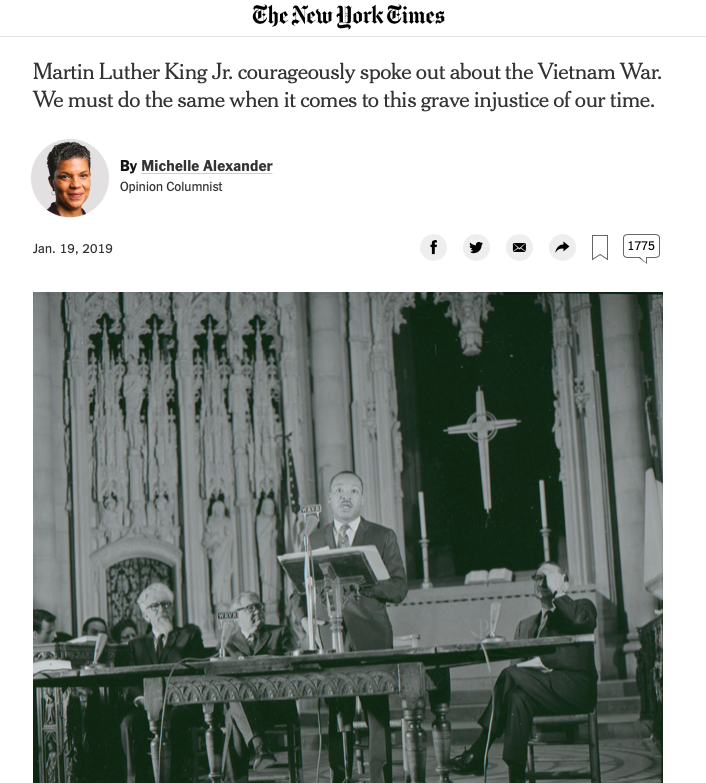
Screengrab from The New York Times
I was deeply inspired by Alexander’s column and her decision to speak so honestly about the difficulty of overcoming the fear of backlash over taking a public stand against the Israeli occupation of Palestine.
Striking a comparison between the risk taken by prominent critics of Israel and the risk Dr. Martin Luther King Jr. took by publicly criticizing the Vietnam War, Alexander observes,
“Those who speak publicly in support of the liberation of the Palestinian people still risk condemnation and backlash.”
Invoking Dr. King’s exhortation that “a time comes when silence is betrayal,” Alexander reflects on “the excuses and rationalizations that have kept me largely silent on one of the great moral challenges of our time: the crisis in Israel-Palestine.”
Alexander’s words resonated with me, a Jew who uncritically supported Israel for many years until I saw the parallels between US policy in Vietnam and Israel’s occupation of the Palestinian territories. My activism and critical writings have followed a trajectory from Vietnam to South Africa to Israel to Iraq to Afghanistan and other countries where the United States continues its imperial military actions.
My Own Path Toward Speaking Out Against the Israeli Occupation of Palestine
I was born in 1948, the year Israel was created out of whole Palestinian cloth. When tasked with finding a destination for Jews displaced by the Holocaust, the United Nations chose Palestine. Thus began a brutal and illegal occupation that continues to this day.
In his book, Injustice: The Story of the Holy Land Foundation Five, Israeli-American Miko Peleddescribes the 1948 “ethnic cleansing campaign that was sweeping through Palestine like wildfire, destroying everything in its path.” Palestinians call it the “Nakba,” Arabic for “catastrophe.”
My family was not religious but we were proud of our Jewish heritage. My father fought the Nazis in World War II and relatives perished in the Holocaust. My paternal grandmother was an activist against the Tsar during the Russian pogroms. On her way to a Siberian prison, she escaped and, at the age of 18, boarded a ship bound for the United States.
We revered Israel as the homeland of the Jews. At the Passover Seder, we would raise our glasses and intone, “Next year in Jerusalem!” At Sunday School, we gathered coins to plant trees in the Holy Land. It wasn’t until I left home that I learned the truth about Israel and became an outspoken critic of its policies.
In 1967, during my freshman year at Stanford, I came to oppose the war in Vietnam and joined The Resistance, a group of draft resisters and their allies. The following year, I signed up for Students for a Democratic Society, where I learned the war was not an isolated event, but rather part of a long history of US imperialism. But I was still unaware that the war Israel launched in 1967 “completed its occupation of Palestine,” in the words of Peled.
The anti-Vietnam War movement at Stanford challenged my long-held assumptions about US foreign policy. My commitment to ending an unjust war against a people fighting for liberation eventually opened my eyes to the plight of the Palestinian people and Israel’s role in repressing them.
After college, I went to law school and became a peoples’ lawyer. I joined the National Lawyers Guild (NLG), a progressive political-legal organization which I later served as president. The NLG’s guiding motto is, “Human rights are more sacred than property interests.” In the NLG, I met many people who criticized Israel’s illegal policies and US complicity in them.
In 1977, the NLG sent a delegation to Israel and Palestine. The report they issued was the first comprehensive analysis of Israel’s practices published by a non-governmental organization dedicated to the protection of human rights. It documented violations of the 1949 Geneva Conventions by Israel as a belligerent occupant of the West Bank and Gaza.
The allegations in the report disturbed me greatly. They described Israel’s mistreatment of the Palestinians, including house demolitions, administrative detention and torture. The report documented beatings, burning with cigarettes, forced standing while naked for long periods exposed to heat or cold, dousing with hot or cold water, cutting the body with razor blades, biting by dogs, sensory deprivation, sodomizing with bottles or sticks, inserting wires into the penis, electric shocks to sensitive parts of the body, and suspension from the floor with hands or feet tied to a pulley device. Reading the case studies made me physically ill.
Apartheid – From South Africa to Palestine
Alexander, author of The New Jim Crow: Mass Incarceration the Age of Colorblindness, wrote that some of Israel’s practices are “reminiscent of apartheid in South Africa and Jim Crow segregation in the United States.”
After the Palestinians launched the second intifada, or uprising, NLG members went to the region and published a report in 2001. It documented a system of apartheid in Israel and the Occupied Palestinian Territories, as well as the United States’ uncritical support of Israel.
That report describes illegal settlements and bypass roads, restricted movement of Palestinians, discriminatory land policies, differential treatment of Jews and Palestinian non-Jews, and Israeli policing of Palestinian political expression. It also analyzed indiscriminate and excessive use of lethal force against Palestinians, indiscriminate and excessive use of force against Palestinian property, delay and prevention of medical treatment, and collective punishment against the Palestinians.
South Africa’s Archbishop Desmond Tutu, winner of the Nobel Peace Prize, pointed to similarities between apartheid in his country and Israel’s oppression of the Palestinians.
“My voice will always be raised in support of Christian-Jewish ties and against the anti-Semitism that all sensible people fear and detest. But this cannot be an excuse for doing nothing and for standing aside as successive Israeli governments colonize the West Bank and advance racist laws,” Tutu wrote in a Tampa Bay Times article. He noted “Israel’s theft of Palestinian land,” and “Jewish-only colonies built on Palestinian land in violation of international law.”
Tutu cited a 2010 Human Rights Watch report that “describes the two-tier system of laws, rules, and services that Israel operates for the two populations in areas in the West Bank under its exclusive control, which provide preferential services, development, and benefits for Jewish settlers while imposing harsh conditions on Palestinians.” Tutu wrote, “This, in my book, is apartheid. It is untenable.”
On July 19, 2018, the Israeli Knesset passed a law that illegally enshrines a system of apartheid. The legislation, which has the force of a constitutional amendment, says,
“The State of Israel is the national home of the Jewish people, in which it fulfills its natural, cultural, religious and historical right to self-determination.” It continues, “The right to exercise national self-determination in the State of Israel is unique to the Jewish people.”
There is no guarantee of self-determination for the 1.8 million Arabs who make up 20 percent of Israel’s population.
Tutu called on “people and organizations of conscience to divest from . . . Caterpillar, Motorola Solutions and Hewlett Packard,” which profit “from the occupation and subjugation of Palestinians.” He was advocating participation in the non-violent Boycott, Divestment and Sanctions movement (BDS), which Alexander also mentions in her column.
When representatives of Palestinian civil society launched BDS in 2005, they called upon “international civil society organizations and people of conscience all over the world to impose broad boycotts and implement divestment initiatives against Israel similar to those applied to South Africa in the apartheid era … [including] embargoes and sanctions against Israel.”
Israel continues to attack Gaza, described as the world’s largest “open air prison” as Israel maintains a tight blockade, restricting all ingress and egress. Headlines in the mainstream media falsely portray an equivalence of firepower between Israelis and Palestinians in Gaza. But Israel’s use of force greatly exceeds that of the Palestinians, and the asymmetric warfare continues to escalate.
In 2014, Israel mounted an offensive called “Operation Protective Edge,” relentlessly bombing Gaza for nearly two months, killing 2,251 Palestinians, the majority of them civilians. The number of Palestinians wounded was 11,231, including 3,540 women and 3,436 children. On the Israeli side, six civilians and 67 soldiers were killed and 1,600 were injured. Tens of thousands of Palestinians lost their homes and the infrastructure was severely damaged. Israel targeted numerous schools, UN-sanctioned places of refuge, hospitals, ambulances and mosques.
As Operation Protective Edge was winding down, the NLG and other legal organizations sent a letter to the chief prosecutor of the International Criminal Court, urging her to investigate war crimes, genocide and crimes against humanity in Gaza committed by Israel and aided and abetted by US leaders. The letter was based on an article I wrote documenting those crimes.
Criticism of Israel Is Not Anti-Semitic
I have become sharply critical of Israel. An active member of the NLG’s Palestine Subcommittee, I write frequent articles and do media commentary about Israel’s violations of international law. I am also a member of Jewish Voice for Peace and I work in support of BDS.
Years after I first read the 1977 NLG delegation report, I visited Ellis Island, where my grandparents arrived in the United States. It is now a museum. As I walked the route they traveled, I felt very emotional about what they endured. But my deep feelings about the suffering of my ancestors during the Holocaust are not inconsistent with my criticisms of Israel for subjecting the Palestinians to a different kind of oppression.
As stories continue to emerge about Israel’s killing of unarmed protesters at the Gaza border during the Great March of Return, it is increasingly difficult to ignore the facts. Yet even those who see the truth about Israel’s oppression of the Palestinians worry about reprisals for speaking out.
Alexander describes the silence of many civil rights activists and groups, “not because they lack concern or sympathy for the Palestinian people, but because they fear loss of funding from foundations, and false charges of anti-Semitism.” She mentioned the case of Bahia Amawi, a US citizen of Palestinian descent, who lost her Texas elementary school job last year after refusing to pledge in writing that she would not participate in the BDS movement. Glenn Greenwald pointed out the grave danger anti-BDS laws pose to freedom of speech, tweeting,
“The proliferation of these laws – where US citizens are barred from work or contracts unless they vow not to boycott Israel – is the single greatest free speech threat in the US.”
There is a false equivalency between criticizing Israel and being anti-Semitic. Any criticism of Israeli policy is labeled anti-Semitism, even though many Jews—including members of Jewish Voice for Peace, Jewish Center for Nonviolence and IfNotNow—oppose the occupation.
The BDS movement is not anti-Israeli, as it targets the policies, not the people, of Israel. And actions against Israel’s policies, including BDS, do not equate to anti-Semitism. Rafeef Ziadah, a spokesperson for the Palestinian Boycott, Divestment and Sanctions National Committee, says,
“As a matter of principle, the BDS movement has consistently and categorically opposed all forms of racism, including anti-semitism and Islamophobia.”
Palestinian human rights activist Omar Barghouti wrote in The New York Times in 2014,
“Arguing that boycotting Israel is intrinsically anti-Semitic is not only false, but it also presumes that Israel and ‘the Jews’ are one and the same. This is as absurd and bigoted as claiming that a boycott of a self-defined Islamic state like Saudi Arabia, say, because of its horrific human rights record, would of necessity be Islamophobic.”
Even though many persist in equating condemnation of Israel with anti-Semitism, groups like Jewish Voice for Peace continue to gain traction. Jews are increasingly willing to examine the facts on the ground in Israel and the Occupied Palestinian Territories.
And although Congress, dominated by the powerful Israel lobby, continues to give more money to Israel than any other country, two new members of Congress — Representatives Ilhan Omar (D-Minnesota) and Rashida Tlaib (D-Michigan) — support BDS.
Alexander is optimistic: “There seems to be increased understanding that criticism of the policies and practices of the Israeli government is not, in itself, anti-Semitic.”
We in the Jewish community have a special responsibility to fight against the Israeli system of apartheid and its illegal occupation of Palestinian lands. The BDS movement is an effective weapon in this struggle. I urge my fellow Jews to join BDS and oppose Israel’s illegal and inhumane policies in whatever way they can.
*
Note to readers: please click the share buttons above. Forward this article to your email lists. Crosspost on your blog site, internet forums. etc.
Copyright © Truthout. Reprinted with permission.
Marjorie Cohn is professor emerita at Thomas Jefferson School of Law, former president of the National Lawyers Guild, deputy secretary general of the International Association of Democratic Lawyers and a member of Jewish Voice for Peace. Her most recent book, Drones and Targeted Killing: Legal, Moral, and Geopolitical Issues, contains a chapter analyzing Israel’s targeted killing case. She is a frequent contributor to Global Research.