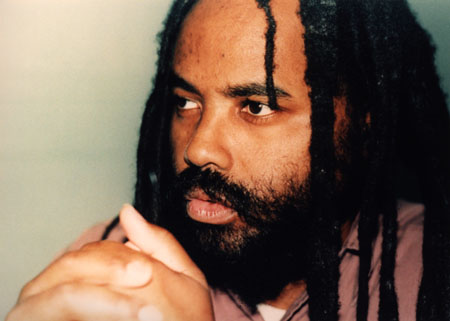
Prison Radio posted this commentary by Mumia Abu-Jamal on Jan. 22, 2025.
Leonard Peltier & Mumia Abu-Jamal
Just a few hours ago, Leonard Peltier left the U.S. prison cell, what Indigenous people call the Iron House, and began the long trek home to North Dakota, where he was [unjustly tried and convicted in1977.] His release by executive clemency, issued by U.S. President Biden, came the same day as some 90 Palestinians were released in Israel, mostly women and juveniles. They were held in detention in Israel, among them [Resistance leader] Khalida Jarrar. Two Indigenous freedom fighters released a world apart on Martin Luther King’s day.
For almost 50 years, Leonard Peltier has been in the Iron House, from 1976 to January 2025, where he now suffers from diabetes, numbness in his hands and feet and near blindness after a trial that officials at the United Nations called a violation of international law. Today Leonard Peltier goes home. Today Indigenous people across Turtle Island, or America, walk a little straighter. Today a victory in a long, long war is won.
With love, not fear, this is Mumia Abu-Jamal.
[Note: Leonard Peltier’s commutation calls for a Feb 18, 2025, release date.]
It comes as no surprise that fuckface trump has sided with the ultra-fascists in israel. As if the regular fascists weren't bad enough, he's allied himself with assholes even to the right of that.
How can you suggest ethnically cleansing a region, and not realize what the fuck you're saying ? Or maybe he does know and doesn't care, which is a likely scenario.
Trump’s proposed plan to “cleanse” Gaza and forcibly relocate Palestinians has sparked outrage, with backing from Israeli far-right leaders Ben-Gvir and Smotrich.
US President Donald Trump has proposed a controversial plan to ethnically cleanse Palestinians from Gaza, suggesting that Egypt and Jordan accept them as part of a broader initiative to achieve “peace” in the Middle East.
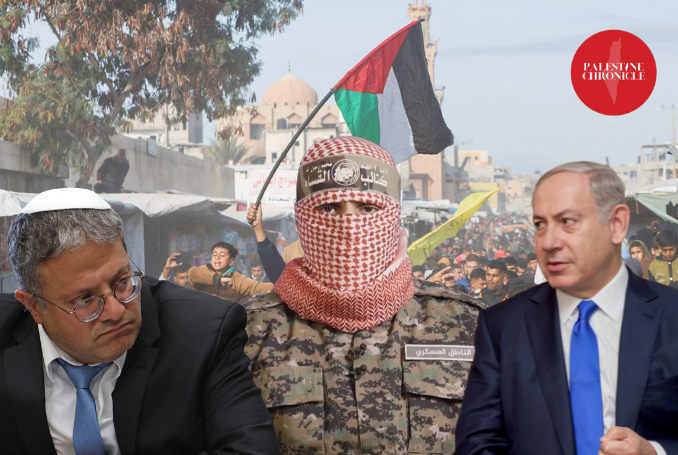
The plan, described by Trump himself as a way to “cleanse” Gaza, has received immediate backing from Israel’s far-right National Security Minister Itamar Ben-Gvir and Finance Minister Bezalel Smotrich.
Trump, who referred to Gaza as a “devastated place,” claimed to have discussed the idea with Jordan’s King Abdullah II and planned further talks with Egypt’s President Abdelfattah El-Sisi.
Jordan’s state news agency Petra reported on the call with Trump but did not reference any plans to relocate Palestinians.
Speaking aboard Air Force One, Trump said, “You’re talking about a million and a half people, and we just clean out that whole thing”.
Trump continued by saying that over the centuries, this area has seen many conflicts, and that “something has to happen, but it’s literally a demolition site right now.”
“Almost everything’s demolished and people are dying there, so I’d rather get involved with some of the Arab nations and build housing in a different location where I think they could maybe live in peace for a change,” he said
He added that the transfer could be temporary or long-term and hinted at building housing elsewhere for displaced Palestinians.
The former president also announced he had ordered the Pentagon to release a shipment of 2,000-pound bombs to Israel, which had been frozen under Joe Biden’s administration, emphasizing his “steadfast support” for Israel.
Far-right Israeli ministers openly expressed their support.
Ben-Gvir praised Trump’s plan, calling for Israel to encourage the “voluntary migration” of Palestinians. Smotrich echoed this, describing the mass displacement as a “great idea” and committing to work toward its implementation.
Both have long advocated for the ethnic cleansing and forced removal of Palestinians from Gaza.
The war in Gaza, which began on October 7, 2023, has already displaced millions, leaving behind devastation and one of the worst humanitarian crises in recent history.
Between October 2023 and January 2025, Israeli attacks in Gaza resulted in over 158,000 deaths and injuries, most of them women and children, with over 14,000 still missing.
The short answer is no, the fascist state of israel did not win. However, they did succeed in eliminating ( murdering ) a large percentage of Gaza's population, which is always a goal for that state. Of course the ultimate point is to completely rid the area of the Palestinian people , and repopulate ( settle ) it with their own. But the bottom line is they did not succeed, at least not yet.
The Resistance continues.
Gaza Ceasefire at Last: How Israel’s ‘First Defeat’ Will Shape the Country’s Future
Unlike previous military campaigns in Gaza—on a much smaller scale compared to the current genocidal war—there is no significant strand of Israeli society claiming victory.
The headline in the Times of Israel says it all: “For the First Time, Israel Just Lost a War.”
Regardless of the reasoning behind this statement, which the article divides into fourteen points, it suggests a shattering and unprecedented event in the 76-year history of the State of Israel. The consequences of this realization will have far-reaching effects on Israelis, impacting both this generation and the next. These repercussions will penetrate all sectors of Israeli society, from the political elite to the collective identity of ordinary Israelis.
Interestingly, and tellingly, the article attributes Israel’s defeat solely to the outcome of the Gaza war, confined to the geographical area of the Gaza Strip. Not a single point addresses the ongoing crisis within Israel itself. Nor does it explore the psychological impact of what is being labeled as Israel’s first-ever defeat.
Unlike previous military campaigns in Gaza—on a much smaller scale compared to the current genocidal war—there is no significant strand of Israeli society claiming victory. The familiar rhetoric of “mowing the lawn”, which Israel often uses to describe its wars, is notably absent. Instead, there is a semi-consensus within Israel that the ceasefire deal was unequivocally bad, even disastrous for the country.
The word “bad” carries broad implications. For Israeli National Security Minister Itamar Ben-Gvir, it represents a “complete surrender”. For the equally extremist Finance Minister Bezalel Smotrich, it is a “dangerous deal” that compromises Israel’s “national security”.
Israeli President Isaac Herzog refrained from offering political specifics but addressed the deal in equally strong terms: “Let there be no illusions. This deal—when signed, approved and implemented—will bring with it deeply painful, challenging and harrowing moments.”
Foreign Minister Gideon Sa’ar, along with other Israeli officials, tried to justify the deal by framing Israel’s ultimate goal as the freeing of captives. “If we postpone the decision, who knows how many will remain alive?” he said.
However, many in Israel, along with an increasing number of analysts, are now questioning the government’s narrative. Israeli Prime Minister Benjamin Netanyahu had previously rejected similar ceasefire agreements in May and July, impeding any possibility of negotiation.
In the time between those rejections and the eventual acceptance of the deal, tens of thousands of Palestinians have been killed or wounded. While these tragedies have been entirely disregarded or dismissed in Israel, many Israeli captives were also killed, mostly in Israeli military strikes.
Had Netanyahu accepted the deal earlier, many of these captives would likely still be alive. This fact will linger over whatever remains of Netanyahu’s political career, further defining his already controversial and corruption-riddled legacy.
Ultimately, Netanyahu has failed on multiple fronts. Initially, he wanted to prevent his right-wing, extremist coalition from collapsing, even at the expense of most Israelis. As early as May 2024, many prioritized the return of captives over the continuation of war. Netanyahu’s eventual concession was not driven by internal pressure, but by the stark realization that he could no longer win.
The political crisis that had been brewing in Israel reached a breaking point as Netanyahu’s administration scrambled to navigate the growing discontent. In an article published soon after the ceasefire announcement, Yedioth Ahronoth declared Netanyahu politically defeated, while his Chief of Staff, Herzi Halevi, was blamed for military failure.
In reality, Netanyahu has failed on both fronts. Military generals repeatedly urged him to end the war, believing Israel had achieved tactical victories in Gaza. During the war, Israel’s political and social crises deepened.
Netanyahu, at the helm, resorted to his old tactics. Instead of demonstrating true leadership, he engaged in political manipulation, lied when it suited him, threatened those who refused to follow his rules and deflected personal responsibility. Meanwhile, the Israeli public became increasingly disillusioned with the war’s direction and frustrated with Netanyahu and his coalition.
In the end, the entire Kafkaesque structure of Israeli governance collapsed. The failure to manage both the political crisis and the military strategy left Israel’s leadership weakened and increasingly isolated from the public.
Of course, Netanyahu will not give up easily. He will likely attempt to satisfy Ben-Gvir by insisting that Israel retains the right to return to war at any time. He will likely enable Smotrich to expand illegal settlements in the West Bank and may try to redeem the military’s reputation by escalating operations there.
These actions may buy Netanyahu some time, but they will not last. The majority of Israelis now seek new elections. While previous elections have ignored Palestinians, the next election will be almost entirely defined by the Gaza war and its aftermath.
Israel is now facing the reality of a political and military failure on a scale previously unimaginable. Netanyahu’s handling of the situation will be remembered as a key moment in the country’s history, and its consequences will continue to affect Israeli society for years to come.
Netanyahu’s departure from the political stage seems inevitable—whether because of the war’s outcome, the next elections or simply due to illness and old age. However, the material and psychological impacts of the Gaza war on Israeli society will remain, and they are likely to have irreversible consequences. These effects could potentially threaten the survival of Israel itself.
– Ramzy Baroud is a journalist and the Editor of The Palestine Chronicle. He is the author of six books. His latest book, co-edited with Ilan Pappé, is “Our Vision for Liberation: Engaged Palestinian Leaders and Intellectuals Speak out”. Dr. Baroud is a Non-resident Senior Research Fellow at the Center for Islam and Global Affairs (CIGA). His website iswww.ramzybaroud.net
Below is Mumia Abu-Jamal’s message to the 3,000 people attending the Jan. 11, 2025, Rosa Luxemburg Conference in Berlin in person plus 25,000 on livestream, organized by junge Welt and supported by the Mumia German Collective. (jungewelt.de)
Mumia Abu-Jamal
Who runs the world? Hallo Freunde, wie gehts? [Hello friends, how’s it going?]
As we look out into the world, we once again view the spectacle of war. It is, to be sure, a colonial war: one fought by a regional hegemon, Israel, against what is essentially an unarmed population, Gaza, but one side has the most sophisticated weapons, including fighter jets, while the other side has, well, rocks. To be fair, the other side has missiles, yet, but most of them are unable to pierce what has been called the Iron Dome [in Israel], which safely detonates over 90% of all missiles, which are incoming.
One is reminded of the overwhelming power of the U.S. military when it launched the Iraq War, and later, the war in Afghanistan, in March and August of 2003 respectively. The Iraq War promised, in the words of former U.S. President George W. Bush, weaponry that would evoke both shock and awe. It turned out to be disastrous, in the human and social costs, with millions becoming refugees and both societies shattered.
The wars began as a kind of neoconservative fever dream. Took trillions out [of] the U.S. budget and did little to support U.S. objectives. The Iraq War, pitched as a search for weapons of mass destruction, found nothing of value or strategic. As for Afghanistan, the U.S. negotiated a withdrawal that left the Taliban in control of the ancient country that became known as the graveyard of empires. And although the neocons launched the wars to change the face of the Middle East, most foreign affairs scholars consider the Iraq-Afghanistan wars as two of the biggest blunders in American foreign policy and foreign affairs.
What this shows us is that there is a limit to the reach of military power. Countries can mobilize truly, but if they can’t reach their objectives, that weaponry is wasted.
The Iraq-Afghanistan wars are also instructive in another respect. They were preceded by the biggest anti-war protests in world history. But what’s the point, you ask? Didn’t these protests around the world, mass marches, fail? Yes, if you mean they failed to stop the wars. But history has another judgment. For history shows that they, the people, were right and their elected leaders, the neocon think tanks, much of the corporate media and of course the military-industrial complex, were wrong.
It also means that in the future, protests may have to actually be bigger, bigger and bigger. And perhaps labor actions should be integrated into such protests. Those vast protests show the leakages and to be honest, the weaknesses of representative democracy, for when the so-called representative ignores the will of the people, that’s not democracy. That’s the opposite of democracy. That’s autocracy under a democratic mask.
So who runs the world? The people do when they fight long enough, hard enough. The great Black leader Frederick Douglass once said: “Power concedes nothing without a demand. It never did and never will.” So make the demand and build, make the demand and build with love, not fear.
Hier spricht Mumia Abu-Jamal. Auf Wiedersehen. [This is Mumia Abu-Jamal speaking. Goodbye until next time.]
Not since The Warsaw Ghetto Uprising have we seen such resilient defiance in the face of insurmountable odds as we see today. The Palestinian Resistance continues to fight and even inflict defeats on an absolutely superior force , aided by the most brutal killing regime in the history of the world , the united states of amerikkka. Simply astounding and inspirational.
The Flood of the Free: The march to liberation
Please note: All names and numbers below are subject to further clarification as official statements are released by the Palestinian Resistance and the Prisoners’ Media Office, the only authoritative source of information on the releasees of the Flood of the Free.
This morning, Sunday, 19 January, as the sun rises in Gaza, as the people of the north return home without anyone searching or interrogating them, in preparation for a greater march home to all of occupied Palestine and their original homes and lands, as Jabalia and Nuseirat camps are filled with its people and families, from the heroic resistance fighters that made the camp a death trap for the genocidal enemy until its last moment, as the doctors, nurses and health workers reopen the hospitals, as the Palestinian police, interior ministry and civil defense — so heavily targeted by the occupier — fan out throughout Gaza, as the Qassam Brigades march in public, welcomed by the people, throughout Gaza; Palestinian prisoners inside the occupation jails are awaiting their liberation in the exchange agreement, Toufan al-Ahrar, the Flood of the Free — liberated by the Palestinian resistance and the great sacrifices of Gaza, accompanied by those throughout Palestine, of Lebanon, Yemen, Iran and Iraq.
The Zionist entity attempted to undermine the ceasefire, outraged by the Palestinian exultation of the achievements of the resistance and their own clear defeat, in the earliest moments, taking another 10 martyrs, claiming that the Resistance had not turned over the list of three prisoners held by the resistance to be released today (despite the fact that such lists were not part of the agreement). However, the people continued their return. In the words of Palestinian writer Ali Abunimah, “Enemy is still bombing, shelling in Gaza, but people are still celebrating and streaming home, civil authorities getting back to work and the mayor of Rafah held a press conference. This too is defiance and resistance. People aren’t going to let the enemy spoil their ceasefire.”
The occupation has released an overall list of names of the prisoners to be liberated within the first stage of the agreement, a process that will take place over 42 days. The occupation does not release these lists in order to provide information to or facilitate the preparation of Palestinians; rather, it is a requirement of internal occupation law to allow Zionists to object to the liberation of these captives.
This list and even the full group of prisoners to be freed in the first stage is not the entire reach of the Flood of the Free; especially as many of the leadership prisoners and those with high sentences are expected to be demanded to be released in the second stage of the exchange, in return for high-ranking Zionist captives held by the resistance.
The names on the list published by the occupation are exciting and inspiring, including so many of the great leaders of the Palestinian liberation struggle; three of the heroes of the Freedom Tunnel; Nael Barghouthi, the longest-held Palestinian prisoner; Mohammed Abu Warda, with 45 life sentences; Khalida Jarrar, the leading Palestinian academic and leftist; Ammar al-Zaben, the first Palestinian prisoner to conceive a child through “smuggled sperm;” Dirar al-Sisi, the Palestinian engineer kidnapped from Ukraine in 2011; Hadeel Shatara, the Palestinian educator and activist; Iyad Jaradat, who endured years in solitary confinement; Wael Jaghoub, the Palestinian leader and writer behind bars; Bushra al-Taweel, the tireless chronicler of the Palestinian prisoners’ cause; the ill strugglers like Moatassem Raddad and Mansour Muqtada; Abla Sa’adat, the wife of Ahmad Sa’adat — and so many more.
However, we also know that the exchange will be completed in stages and throughout the 42 days, and that the Resistance — the great Resistance that achieved their liberation — is the only trustworthy source of information, and will be coordinating the release of the lists of names of prisoners to be exchanged each day of the releases.
We are committed to provide immediate translations and information as soon as they are available on an ongoing basis.
1,737 male and female prisoners will be released from Israeli occupation prisons by the Resistance as part of the FIRST PHASE ONLY of the Flood of the Free.
We urge everyone, around the world, to join with the Palestinian people in Gaza and everywhere, to celebrate the achievements of the Resistance and the humiliation of the occupier, and to celebrate and welcome each liberated prisoner as the heroes of our global movement that they are, in public events, with posters and public education, with actions and events exposing Zionism and imperialism everywhere.
The Week of Action to Free Ahmad Sa’adat and all Palestinian Prisoners is continuing amid the Flood of the Free — this is an excellent opportunity to highlight the prisoners with lengthy sentences and support the resistance’s demand for their liberation, while celebrating the exceptional accomplishments of the Flood of the Free on a daily basis.
We urge all supporters of Palestine and Palestinian and Arab communities to receive and honour the prisoners virtually and symbolically — and pledge to continue the movement until all of them are free, and all of Palestine is free, from the river to the sea.